How to track your bowel movements on iPhone
Whether a doctor asked you to keep a record or you just want to understand your own patterns, your phone is the thing you always have with you. Here are the options, what Apple Health covers, and what is worth recording each time.
Updated October 24, 2026 · 6 min read · By the Log For Your Log team · 7 sources
 Log each bowel movement by Bristol type in a couple of taps. Free on iPhone.Get the app

General information, not medical advice. This page can help you notice patterns and talk with a clinician. It cannot tell you what is causing a symptom.
Why track your bowel movements
Memory is not a reliable record. If a doctor asks how often you have been going over the past month, or what your stools usually look like, it is hard to answer accurately on the spot.
Those details matter. NIDDK says that when doctors assess irritable bowel syndrome (IBS), they look for a certain pattern in your symptoms, including whether your pain is related to bowel movements, a change in how often you have a bowel movement, and a change in the way your stools look. The NHS says a GP will ask what symptoms you have, whether they come and go, how often you get them, when you get them and how long you have had them, and that it may help to write down details before your appointment.
Frequency matters for constipation too. The NHS says it is likely to be constipation if you have not had a poo at least 3 times during the last week or are going less often than usual, or if your poo is unusually large or small and dry, hard or lumpy. Without a record, you are guessing.
What to record each time
Keep it short enough that you will actually do it. These are the details that answer the questions doctors ask:
| Detail | Example | Why it helps |
|---|---|---|
| Date and time | Tuesday, 07:40 | Shows how often you go and whether there is a usual time |
| Stool type | Bristol type 4 | Shows changes in how your stools look over time |
| Color | Medium brown | Unusual colors are worth noting for a doctor |
| Symptoms | Cramps before, felt incomplete | Shows whether pain is linked to bowel movements |
| Meals and drinks | Oatmeal, banana and coffee | Helps spot food and drink patterns |
| Water | 6 glasses | Low fluid days can come before harder stools |
| Note | Stressful morning, slept badly | Captures things you would otherwise forget |
Use a shared scale for stool type
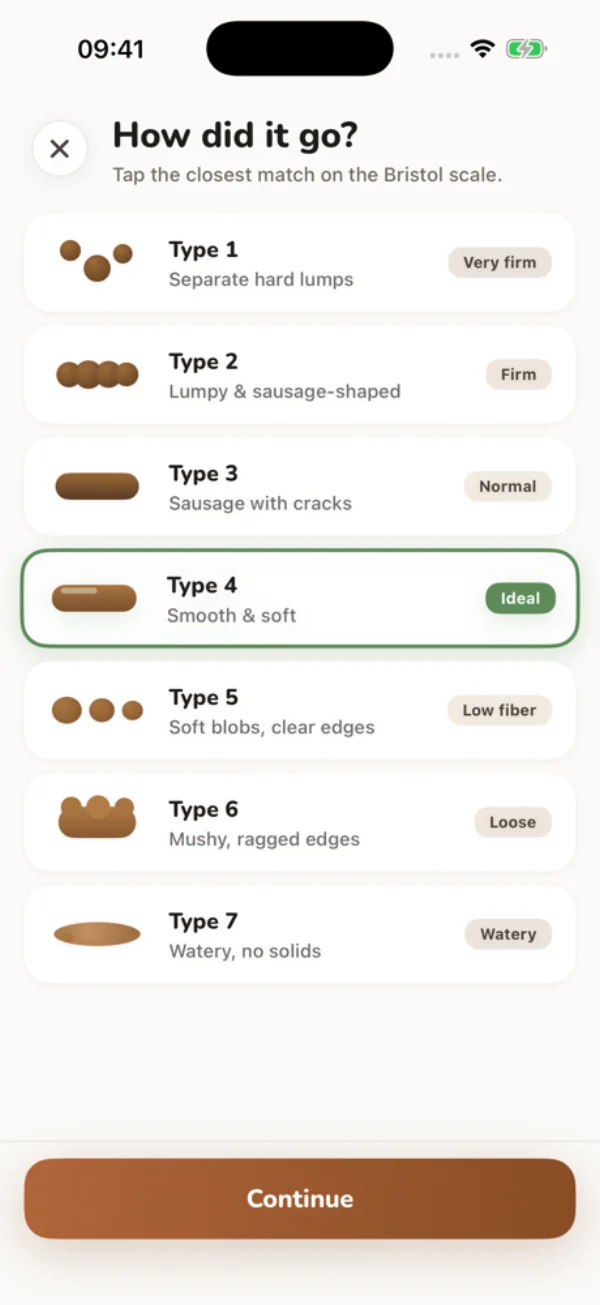
The Bristol stool chart sorts stools into seven types, from hard lumps (type 1) to watery (type 7). Using it means you and your doctor are describing the same thing. Our Bristol stool chart guide explains each type, and our poop color guide covers colors.
Can Apple Health track bowel movements?
Partly. Apple's developer documentation for HealthKit, the system that stores data for the Health app, lists symptom type identifiers that include abdominal cramps, bloating, constipation, diarrhea, heartburn and nausea. HealthKit also has types for the amount of water and fiber consumed.
What we did not find in that list is a type for stool form (such as a Bristol type), stool color, or a simple count of bowel movements. So Health can hold a record of symptoms like constipation or diarrhea, but on its own it is not a full bowel movement diary.
If you want to add data by hand, Apple Support describes the steps:
- Open the Health app and tap the Browse tab.
- Tap a category, then tap a subcategory.
- Tap Add Data, enter the date, time and data, then tap Done.
Other ways to keep a record
There is no single right method. Here are the common options and their trade-offs:
- A paper diary. Simple, private and easy to hand to a doctor. The downside is remembering to carry it and spotting patterns by eye. Our free printable Bristol stool chart and 2 week diary is set up for exactly this.
- A notes app or spreadsheet. Free and always on your phone. It works well if you use the same format every time, such as date, time, type, color and a short note. It takes more effort to see trends.
- A dedicated tracking app. Built for the job, so logging is usually quicker and patterns are easier to see. Before choosing one, check what it records, where your data is stored and what it costs.
- Apple Health. Useful for symptoms, water and fiber, as above, but without a stool type or color field in the documentation we read.
How Log For Your Log works
This is our app, so here are the plain facts. Log For Your Log logs each bowel movement by Bristol type, from 1 to 7, and by color, with an optional note. You can also log meals, water, symptoms and how you feel. A calendar keeps each day's logs together, and weekly insights summarize your patterns. There are small tools for hydration, fiber and movement, plus a posture guide.
It is free to start on iPhone and you do not need an account. Your logs stay on your device unless you choose to turn on optional sync. It is a wellness tracker, not a medical device, so it cannot tell you what is causing a symptom. What it can do is give you an accurate record to talk through with a clinician.
Make the habit stick
- Log straight away. It is easy to forget details by the end of the day, so a quick entry right after works best.
- Keep it consistent. Use the same scale and wording each time so weeks are comparable.
- Log the normal days too. A record of only bad days makes it impossible to compare.
- Give it time. NIDDK says doctors look for a pattern over time, such as symptoms at least once a week in the last 3 months, so a few days of entries will not tell you much.
- Add food when you can. NIDDK suggests that people with chronic diarrhea track what they eat and drink, what symptoms they have, when symptoms occur and which foods and drinks make symptoms worse. Our food and symptom diary guide explains how.
Bring your record to appointments
A summary helps more than pages of raw entries. Before an appointment, note how many times a week you usually go, the types you see most often, any change from your usual pattern and when it started, and which symptoms come with it. Our appointment prep guide has a checklist.
A record is not a substitute for advice. If you notice blood in your stool, black or tarry stool, weight loss you cannot explain, or a change in your usual pattern that lasts more than a few weeks, see a doctor. Our when to see a doctor guide lists the signs.
Common questions
Can Apple Health track bowel movements?
Not fully. Apple's HealthKit documentation lists symptom types such as constipation, diarrhea, bloating and abdominal cramps, but we did not find a type for stool form, color or a count of bowel movements.
How do I add data to the Health app manually?
Apple Support says to open Health, tap Browse, choose a category and subcategory, tap Add Data, enter the date, time and data, then tap Done.
What is the best way to track bowel movements?
The one you will keep up. Paper diaries, notes apps and dedicated apps all work if you record the same details each time: time, stool type, color, symptoms, and ideally meals and water.
Is there a printable bowel movement tracker?
Yes. Our free printable Bristol stool chart and 2 week diary has the chart on one page and a two week log on the other.
How long should I track my bowel movements before seeing a doctor?
Do not wait to track if you have warning signs such as blood in your stool. For ongoing symptoms, the NHS says to see a GP if you think you might have IBS and have had symptoms for over 4 weeks. Bring whatever record you have.
When to talk to a doctor
Contact a doctor promptly if you notice any of these. Get urgent help if you also feel faint, dizzy or very unwell.
- Blood in your stool, or black, tarry stool
- Pale, clay colored or white stool
- Losing weight without trying
- Severe or ongoing tummy pain
- A change in your usual pattern that lasts more than a few weeks
- Diarrhea with signs of dehydration, such as dizziness or very little urine
Sources
- Symptom type identifiers (HealthKit), Apple Developer
- Manage Health data on your iPhone, iPad, or Apple Watch, Apple Support
- Diagnosis of irritable bowel syndrome, NIDDK (NIH)
- Eating, diet and nutrition for diarrhea, NIDDK (NIH)
- Getting diagnosed with IBS (irritable bowel syndrome), NHS
- Symptoms of IBS (irritable bowel syndrome), NHS
- Constipation, NHS
How this page was made. Written by the Log For Your Log team with AI drafting help, then checked line by line against the sources below, including Apple's own documentation. Read how we write Learn.