Free printable Bristol stool chart and 2 week diary
Two pages, free, no sign-up. Page one is a Bristol chart in plain words. Page two is a two week diary for meals, symptoms and stool types.
Updated October 22, 2026 · 3 min read · By the Log For Your Log team · 4 sources
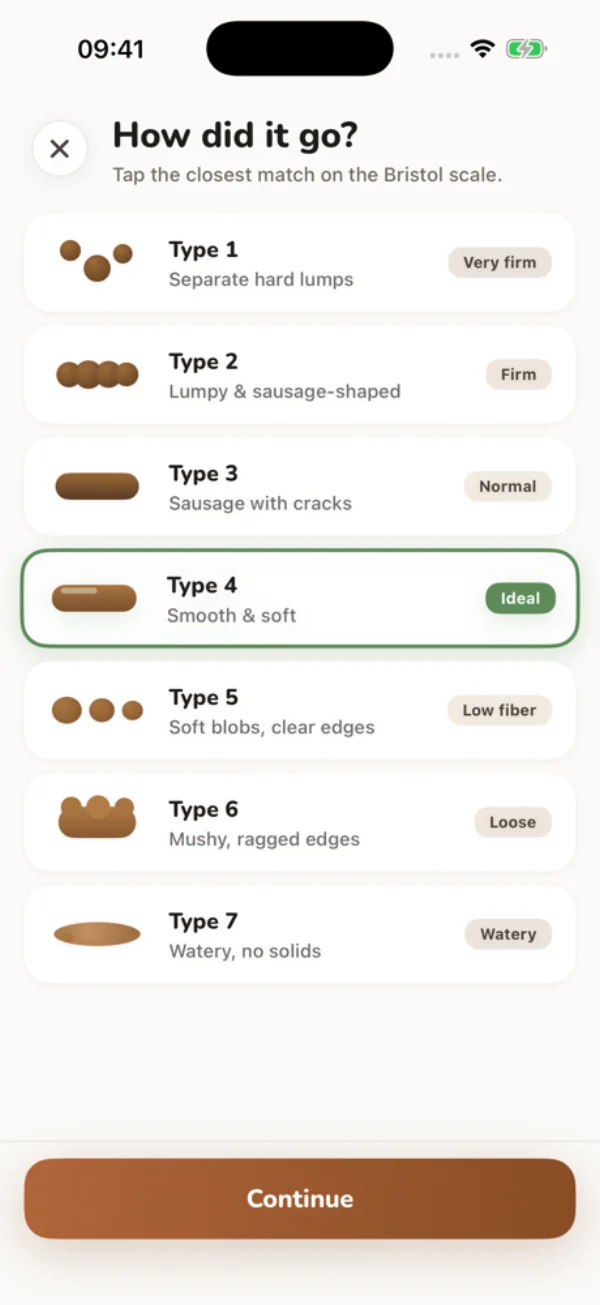
 Prefer your phone? The same log, in an app. Free on iPhone.Get the app

General information, not medical advice. This page can help you notice patterns and talk with a clinician. It cannot tell you what is causing a symptom.
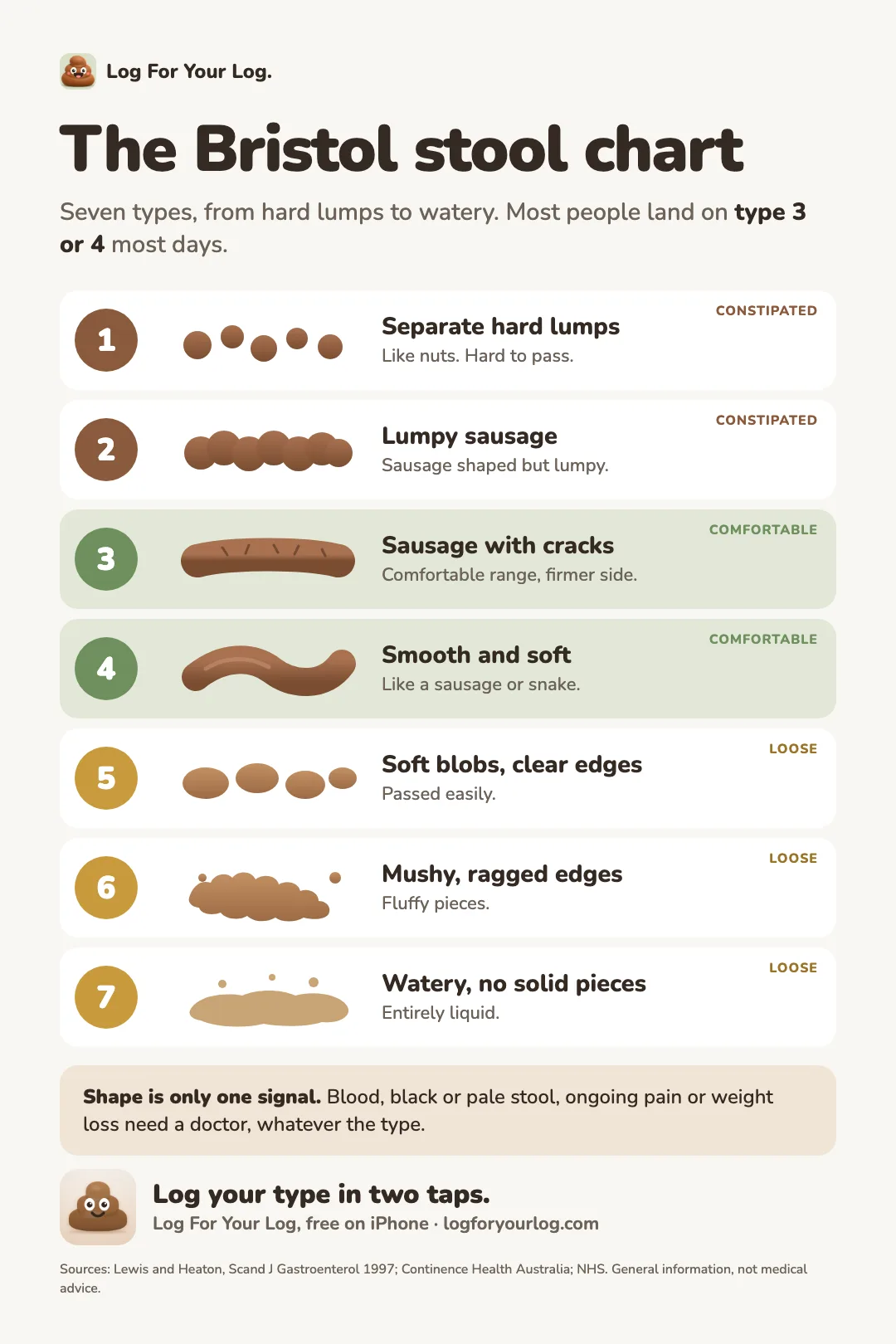
Download the chart and diary
No email, no account. Print as many copies as you like for yourself, your family, or your patients.
No PDF viewer? Open the print-ready web version and print it straight from your browser.
Download the free PDF PDF, 2 pages, 83 KB. US Letter, prints fine on A4.
What is inside
- Page 1, the Bristol stool chart. All seven types in plain words, color coded into the three groups Continence Health Australia uses: types 1 and 2 suggest constipation, 3 and 4 are healthy and easy to pass, 5 to 7 suggest diarrhea or urgency. It also has a short how-to and the warning signs worth a doctor.
- Page 2, the two week diary. 28 lines (two a day) with columns for date, time, Bristol type, color, meals and drinks, symptoms from 0 to 10, and notes.
How to use it
- Keep page 1 where you go, and page 2 somewhere you will see it, like the kitchen.
- Fill in a line right after a bowel movement or when a symptom starts. Quick and honest beats perfect.
- Add meals and drinks as you have them. Reactions can come hours later, so the times matter.
- After two weeks, look for repeats, not one-off days. Our food and symptom diary guide explains how to read it.
- Bring both pages to your appointment. The NHS suggests a food and symptom diary for IBS, and a doctor may ask you to keep one when food intolerance is suspected.
Use it in your clinic, school or blog
You are welcome to print and hand out the PDF. It carries our name and web address but no sign-up, and it is not tied to the app. The original scale is from Lewis and Heaton (1997); the descriptions on our chart are our own wording, not a copy of any published chart image.
Licence: free to print and share unchanged, with credit to Log For Your Log. Please do not edit the chart or remove our name and web address. Linking to this page is always welcome.
If you share it on a website or resource list, this credit line works well:
<p>Bristol stool chart and diary: <a href="https://logforyourlog.com/learn/printable-bristol-stool-chart/">free printable from Log For Your Log</a></p>
Common questions
Is the Bristol stool chart free to use?
Our printable is free for personal and clinical use. The chart descriptions are our own wording, based on the scale published by Lewis and Heaton in 1997, not a copy of a published chart image.
What paper size is the printable?
US Letter. It also prints on A4 with your printer's fit-to-page setting.
How do I fill in the diary?
One line per bowel movement or symptom: date, time, Bristol type 1 to 7, color, meals and drinks, a 0 to 10 symptom score and notes. Page two shows an example line.
What do the colors on the chart mean?
They follow the grouping Continence Health Australia uses: types 1 and 2 suggest constipation, 3 and 4 are healthy and easy to pass, and 5 to 7 suggest diarrhea or urgency.
When to talk to a doctor
Contact a doctor promptly if you notice any of these. Get urgent help if you also feel faint, dizzy or very unwell.
- Blood in your stool, or black, tarry stool
- Pale, clay colored or white stool
- Losing weight without trying
- Severe or ongoing tummy pain
- A change in your usual pattern that lasts more than a few weeks
- Diarrhea with signs of dehydration, such as dizziness or very little urine
Sources
- Bristol Stool Chart, Continence Health Australia
- Stool form scale as a useful guide to intestinal transit time, Lewis SJ, Heaton KW. Scandinavian Journal of Gastroenterology, 1997
- Irritable bowel syndrome: diet, lifestyle and medicines, NHS
- Food intolerance, NHS
How this page was made. Designed by the Log For Your Log team. The chart descriptions are our own plain-language wording; the type grouping and warning signs come from the sources below. Read how we write Learn.