When to see a doctor about your poop
Most odd days are just odd days. These are the signs that are not, sorted by how quickly to act, with the official guidance behind each one.
Updated October 21, 2026 · 4 min read · By the Log For Your Log team · 8 sources
 Keep a clear record to bring to appointments. Free on iPhone.Get the app

General information, not medical advice. This page can help you notice patterns and talk with a clinician. It cannot tell you what is causing a symptom.
How to use this page
This page groups warning signs from the NHS and the US National Institute of Diabetes and Digestive and Kidney Diseases (NIDDK) by how quickly they need attention. It is not a full list and it cannot tell you what is causing a symptom. If you are worried, it is always reasonable to ask a doctor, nurse or pharmacist, even if your symptom is not listed here.
Outside the UK, "call 999" means your local emergency number, and "NHS 111" means your local urgent advice line or an urgent appointment.
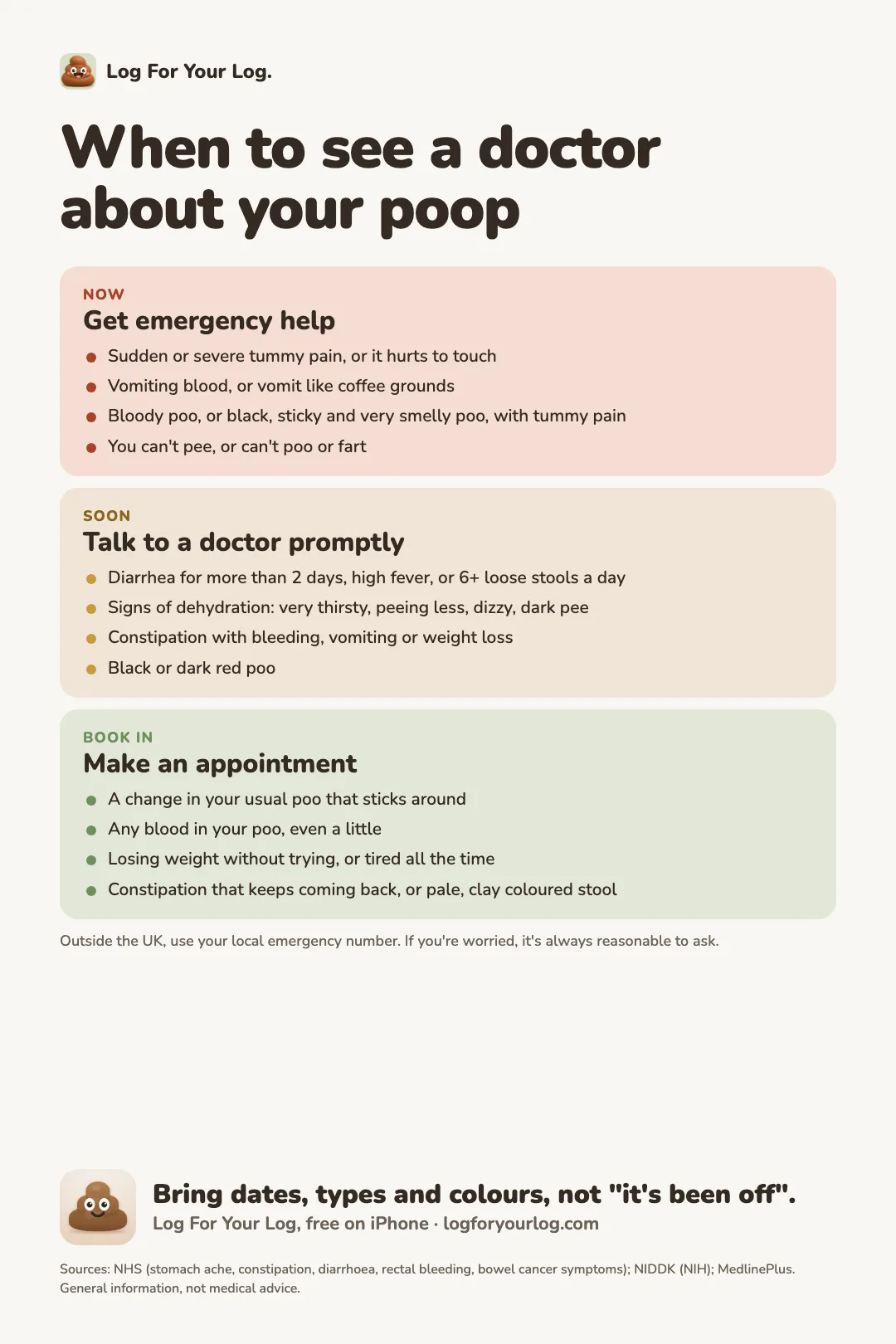
Get emergency help now
The NHS says to call 999 or go to A&E if you have a stomach ache and any of these:
- The pain came on very suddenly or is severe, or it hurts when you touch your stomach.
- You are vomiting blood, or your vomit looks like ground coffee.
- Your poo is bloody, or black, sticky and extremely smelly.
- You cannot pee, or you cannot poo or fart.
Heavy bleeding
For bleeding from the bottom, the NHS says to get emergency help if the bleeding does not stop or there is a lot of blood, for example the toilet water turns red or you see large clots.
Talk to a doctor soon
These signs need a prompt conversation with a doctor rather than waiting to see if they pass.
- Diarrhea with warning signs. NIDDK says adults should talk with a doctor right away for diarrhea lasting more than 2 days, a high fever, six or more loose stools a day, frequent vomiting, severe pain in the abdomen or rectum, stools that are black and tarry or contain red blood or pus, or signs of dehydration.
- Dehydration. NIDDK lists extreme thirst or dry mouth, urinating less than usual, feeling tired, dizzy or lightheaded, and dark urine.
- Constipation with warning signs. NIDDK says to see a doctor right away if constipation comes with bleeding from the rectum, blood in the stool, constant pain in the abdomen, being unable to pass gas, vomiting, fever, lower back pain, or losing weight without trying.
- Black or dark red poo. The NHS advises asking for an urgent GP appointment if your poo is black or dark red.
Book a regular appointment
These are not emergencies, but they are worth getting checked rather than living with. The NHS asks people to try not to be embarrassed: doctors and nurses talk about this every day.
- A change in your usual poo, such as softer stools, diarrhea or constipation that is not usual for you, or going more or less often than usual (NHS).
- Blood in your poo, even a little, or bleeding from your bottom.
- Often feeling like you need to poo even if you have just been.
- Losing weight without trying, or feeling very tired or short of breath.
- Constipation that is not getting better with self-care, or that keeps coming back, or being regularly bloated (NHS).
- Diarrhea that lasts more than 7 days (NHS).
- Pale, clay colored or white stool (MedlinePlus).
People who should check in sooner
NIDDK says people with diarrhea who are pregnant, over 65, taking antibiotics, or have a weakened immune system are more likely to have health problems from it and should keep in touch with their doctor. It also suggests seeing a doctor about constipation if you have a family history of colon or rectal cancer.
How to describe it at your appointment
Appointments are short, and "things have been off" is hard to act on. A few specifics help a clinician much more:
- When it started and whether it is constant or comes and goes.
- How often you go now compared with your usual.
- What it looks like: the Bristol type and color, and any blood or mucus.
- Other symptoms: pain, bloating, fever, weight change, tiredness.
- What you have tried and what changed: food, fluids, medicines, supplements.
Common questions
When should I worry about my poop?
Get help for blood in your poo, black or tarry stool, pale stool, weight loss without trying, severe or ongoing tummy pain, or a change from your usual pattern that lasts. The sections above list exactly what the NHS and NIDDK say, sorted by urgency.
How long is too long for diarrhea?
NIDDK says adults should talk with a doctor right away for diarrhea lasting more than 2 days. The NHS says to get advice for diarrhea lasting more than 7 days. Get help sooner for any warning sign or dehydration.
When is constipation an emergency?
The NHS says to call 999 or go to A&E if you cannot poo or fart along with a stomach ache, or if the pain is sudden or severe. NIDDK says to see a doctor right away if constipation comes with bleeding, constant tummy pain, vomiting, fever, lower back pain or weight loss.
Is a little blood on the toilet paper serious?
It should always be checked. The NHS advises seeing a GP if you have had blood in your poo for 3 weeks, and getting emergency help if the bleeding does not stop or there is a lot of blood.
What should I tell my doctor?
When it started, how often you go now compared with usual, what it looks like (Bristol type, color, any blood or mucus), other symptoms, and what you have tried. A few weeks of logs make this much easier.
Sources
- Stomach ache, NHS
- Symptoms of bowel cancer, NHS
- Bleeding from the bottom (rectal bleeding), NHS
- Constipation, NHS
- Diarrhoea and vomiting, NHS
- Symptoms and causes of diarrhea, NIDDK (NIH)
- Symptoms and causes of constipation, NIDDK (NIH)
- Stools: pale or clay colored, MedlinePlus (NIH)
How this page was made. Written by the Log For Your Log team with AI drafting help, then checked line by line against the NHS and NIH pages listed below. We list warning signs from those sources; we do not add our own. Read how we write Learn.