The Bristol stool chart, type by type
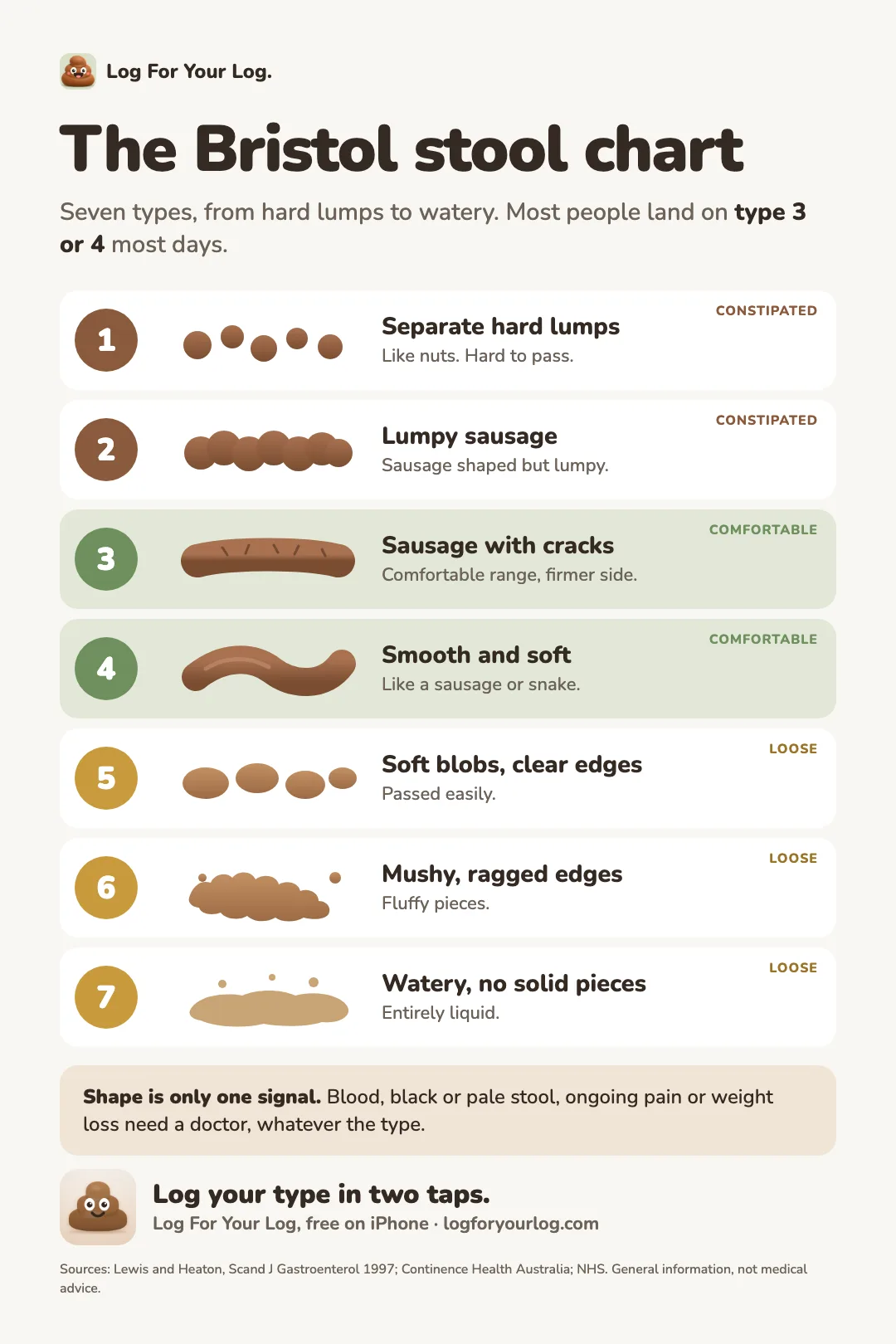
The Bristol stool chart sorts poop into seven types by shape. Types 3 and 4 are the comfortable middle, types 1 and 2 lean constipated, and types 5 to 7 lean loose.
Updated October 22, 2026 · 5 min read · By the Log For Your Log team · 5 sources
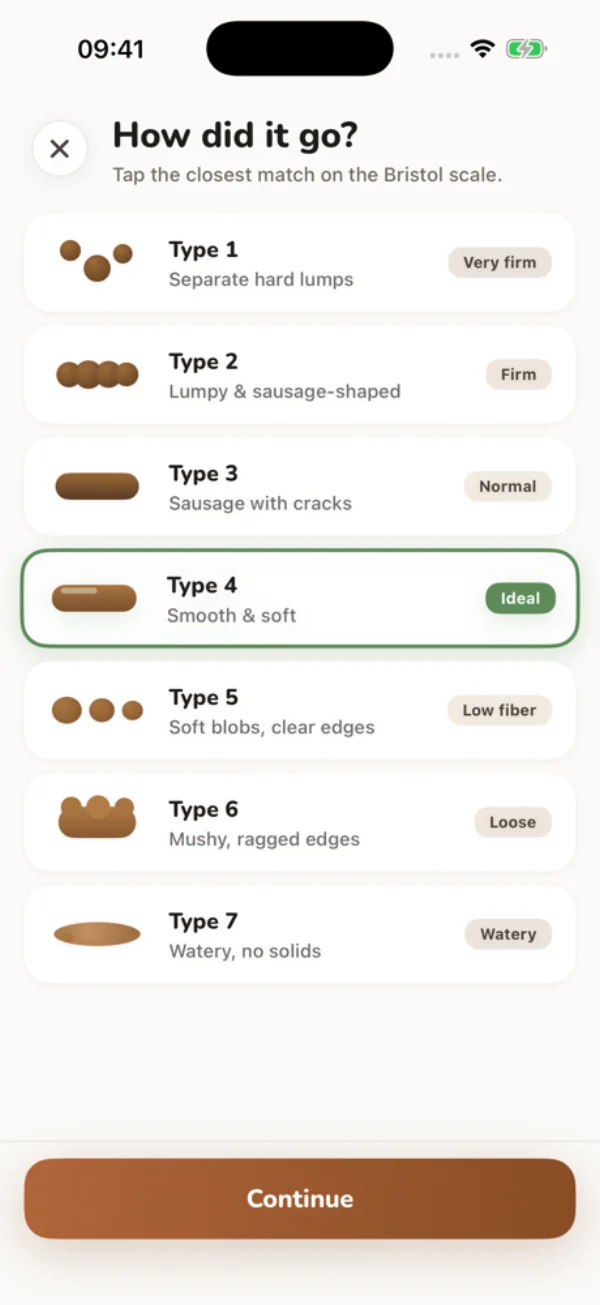
 Log your Bristol type in two taps. Free on iPhone.Get the app

General information, not medical advice. This page can help you notice patterns and talk with a clinician. It cannot tell you what is causing a symptom.
What the Bristol stool chart is
The Bristol stool chart (also called the Bristol stool scale or Bristol stool form scale) sorts poop into seven types by shape and texture. It was published by researchers at the University of Bristol in 1997 (Lewis and Heaton), who found that stool form is a useful rough guide to how quickly food moves through the gut.
Doctors and nurses use it because it swaps vague words like "a bit off" for a number everyone understands. You can use it the same way: as a shared, slightly less awkward language for something everybody does.
The seven types at a glance
Continence Health Australia groups the types simply: types 1 and 2 suggest constipation, types 3 and 4 are healthy and easy to pass, and types 5 to 7 suggest diarrhea or urgency.
| Type | What it looks like | What it usually points to |
|---|---|---|
| Type 1 | Separate hard lumps, like nuts. Hard to pass. | On the constipated end. Stool has spent a long time in the gut. |
| Type 2 | Sausage shaped but lumpy. | Still on the constipated side. |
| Type 3 | Like a sausage with cracks on the surface. | In the comfortable range, on the firmer side. |
| Type 4 | Smooth and soft, like a sausage or snake. | In the comfortable range. Easy to pass. |
| Type 5 | Soft blobs with clear edges. Passed easily. | On the loose side. |
| Type 6 | Fluffy, mushy pieces with ragged edges. | Loose. Mild diarrhea territory. |
| Type 7 | Watery, with no solid pieces. | Diarrhea. |
What counts as normal
Types 3 and 4 are the soft, well formed, easy to pass range (Continence Health Australia), and most people land there most of the time. An occasional 2 or 5 after a big meal, a trip, a late night or a stressful week is common and usually settles by itself.
Normal is also personal. The pattern that matters is yours over a few weeks, not one visit to the bathroom. Someone who is usually a type 4 and has been a type 6 for a month has learned something useful. Someone who had one type 6 after a curry has mostly learned about the curry.
One day is a data point. Two weeks is a pattern.
Before reading anything into a single type, look at what you ate, drank, and how you slept that day. Then watch what the next week brings.
How to use the chart day to day
Prefer paper? Our free printable Bristol stool chart and two week diary puts the chart and a log sheet on two pages you can bring to an appointment.
- Log right after. Pick the closest type while it is fresh. A quick honest guess beats a perfect answer later.
- Add one line of context. What you ate, water, a missed walk, stress, a period, travel or a new medicine. Context turns numbers into explanations.
- Watch the ends of the scale. Spending a lot of time at types 1 and 2, or 6 and 7, is worth paying attention to.
- Change one thing at a time. If you try more fiber or water, change only that for a week or two so you can tell whether it helped.
- Bring the summary to appointments. A few weeks of types is far more useful to a clinician than "it has been weird lately".
What a logged week can look like
Here is an example of the kind of pattern a simple log reveals. It is illustrative, not a target to hit.
| Day | Types logged | Note |
|---|---|---|
| Mon | 4 | Usual routine |
| Tue | 4, 5 | Big curry dinner the night before |
| Wed | 3 | Fewer vegetables, busy day |
| Thu | 2 | Little water, long flight |
| Fri | 3 | Back home, walked 30 minutes |
| Sat | 4 | Usual routine |
| Sun | 4 | Usual routine |
- Most days sit at type 3 or 4, which Continence Health Australia describes as healthy and easy to pass.
- The type 2 day lines up with travel and little water, both on the NHS list of common causes of constipation.
- Nothing here needs action. If the same week repeated for a month with mostly 1s and 2s, or 6s and 7s, that would be worth raising with a doctor.
What the chart does not tell you
Shape is only one signal. Color, blood, pain, weight changes and how long a change lasts all matter, and none of them show up on the Bristol scale. Our guide to poop colors covers color, and the list below, based on NHS guidance, covers the signs that deserve a doctor rather than a chart.
Common questions
What is the healthiest Bristol stool type?
Types 3 and 4 are the range Continence Health Australia describes as healthy: soft, well formed and easy to pass. Type 4, smooth and soft like a sausage, is often called ideal, but a mix of 3s and 4s is normal.
What does the Bristol stool chart measure?
It describes stool shape and texture. The 1997 study behind it found that stool form is a useful rough guide to how quickly food moves through the gut (Lewis and Heaton). Harder types tend to mean slower transit and looser types faster transit.
Is it normal to have different types on different days?
Yes. Food, fluids, travel, stress and sleep all shift things for a day or two. What matters is your usual pattern over a few weeks and whether it changes and stays changed.
When should I worry about my stool type?
Spending most of your time at types 1 and 2, or 6 and 7, is worth discussing with a doctor. So is any lasting change from your usual pattern, which the NHS lists among bowel changes to get checked. Our when to see a doctor guide has the full list.
Can I print a Bristol stool chart?
Yes. Our free printable has the chart on page one and a two week diary on page two, with no sign-up.
When to talk to a doctor
Contact a doctor promptly if you notice any of these. Get urgent help if you also feel faint, dizzy or very unwell.
- Blood in your stool, or black, tarry stool
- Pale, clay colored or white stool
- Losing weight without trying
- Severe or ongoing tummy pain
- A change in your usual pattern that lasts more than a few weeks
- Diarrhea with signs of dehydration, such as dizziness or very little urine
Sources
- Bristol Stool Chart, Continence Health Australia
- Stool form scale as a useful guide to intestinal transit time, Lewis SJ, Heaton KW. Scandinavian Journal of Gastroenterology, 1997
- Definition and facts for constipation, NIDDK (NIH)
- Definition and facts for diarrhea, NIDDK (NIH)
- Constipation, NHS
How this page was made. Written by the Log For Your Log team with AI drafting help, based on our in-app Learn library, then checked line by line against the sources below. Read how we write Learn.