Free printable food and symptom diary (2 weeks, PDF)
Yes, there is a free printable food and symptom diary: two weeks of lines for what you ate, how you felt and how you went. Print the PDF, or print it straight from your browser.
Updated October 22, 2026 · 2 min read · By the Log For Your Log team · 2 sources
 Prefer your phone? The same diary, in an app. Free on iPhone.Get the app

General information, not medical advice. This page can help you notice patterns and talk with a clinician. It cannot tell you what is causing a symptom.
Download the diary
No email, no account. The diary is page two of our free PDF, and page one is a plain-language Bristol stool chart to help you fill in the type column.
No PDF viewer? Open the print-ready web version and print it straight from your browser.
Download the free PDF PDF, 2 pages, 83 KB. US Letter, prints fine on A4.
What the diary asks for
| Column | What to write |
|---|---|
| Date | The day. Two lines per day for two weeks. |
| Time | When you ate, when a symptom started, or when you went. |
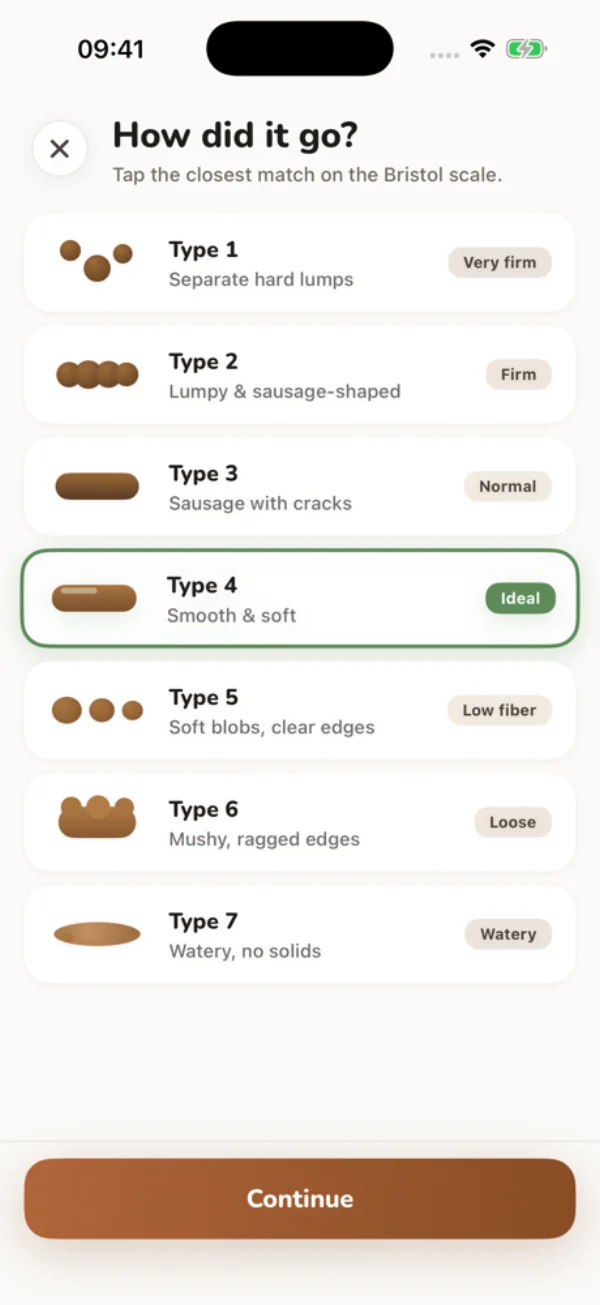
| Type 1 to 7 | The Bristol stool type that matches best. |
| Color | The color of the stool, in your own words. |
| Meals and drinks | What you had, in a few words. Include drinks like coffee or alcohol. |
| Symptoms 0 to 10 | For example bloating 4 or cramps 2. Zero is none and ten is the worst. |
| Notes | Anything else: sleep, stress, a period, travel, a new medicine. |
How to fill it in so it helps
- Write a line when it happens, not at the end of the day. Reactions can come hours after a meal, so the times matter.
- Keep going for the full two weeks. One bad day rarely tells you much; repeats do.
- Look back for patterns: the same food before the same symptom, or symptoms that track sleep or stress. Our food and symptom diary guide shows how to read it.
- Bring it to your appointment. The NHS suggests keeping a food diary for IBS, and a doctor may ask you to keep one when food intolerance is suspected.
When not to wait for the diary to fill
A diary is for patterns, not for warning signs. Blood in your poo, black or tarry poo, losing weight without trying, or severe or ongoing tummy pain are reasons to talk to a doctor now. See when to see a doctor for how quickly to act.
Use it in your clinic, school or blog
Licence: free to print and share unchanged, with credit to Log For Your Log. Please do not edit it or remove our name and web address. Linking to this page is always welcome.
Common questions
Is there a printable food diary that includes symptoms?
Yes. Our free printable has two weeks of lines with columns for meals and drinks, symptoms from 0 to 10, Bristol stool type, color and notes. It is page two of the PDF on this page.
How long should I keep a food and symptom diary?
Two weeks is a practical start, which is why the printable has two weeks of lines. If your doctor or dietitian asks for longer, print more copies.
What should I write in a food and symptom diary?
What you ate and drank and when, each bowel movement with its type and color, any symptoms with a time and a 0 to 10 score, and notes like sleep or stress.
Is there an app version?
Yes. Log For Your Log keeps the same details on your iPhone and is free to start.
When to talk to a doctor
Contact a doctor promptly if you notice any of these. Get urgent help if you also feel faint, dizzy or very unwell.
- Blood in your stool, or black, tarry stool
- Pale, clay colored or white stool
- Losing weight without trying
- Severe or ongoing tummy pain
- A change in your usual pattern that lasts more than a few weeks
- Diarrhea with signs of dehydration, such as dizziness or very little urine
Sources
How this page was made. Designed by the Log For Your Log team. The chart descriptions are our own plain-language wording; the type grouping and warning signs come from the sources below. Read how we write Learn.