How often should you poop?
Short answer: there is no single right number. Here is the range health services describe, and how to work out what is normal for you.
Updated October 21, 2026 · 4 min read · By the Log For Your Log team · 4 sources
 See your real rhythm with a simple log. Free on iPhone.Get the app

General information, not medical advice. This page can help you notice patterns and talk with a clinician. It cannot tell you what is causing a symptom.
The short answer
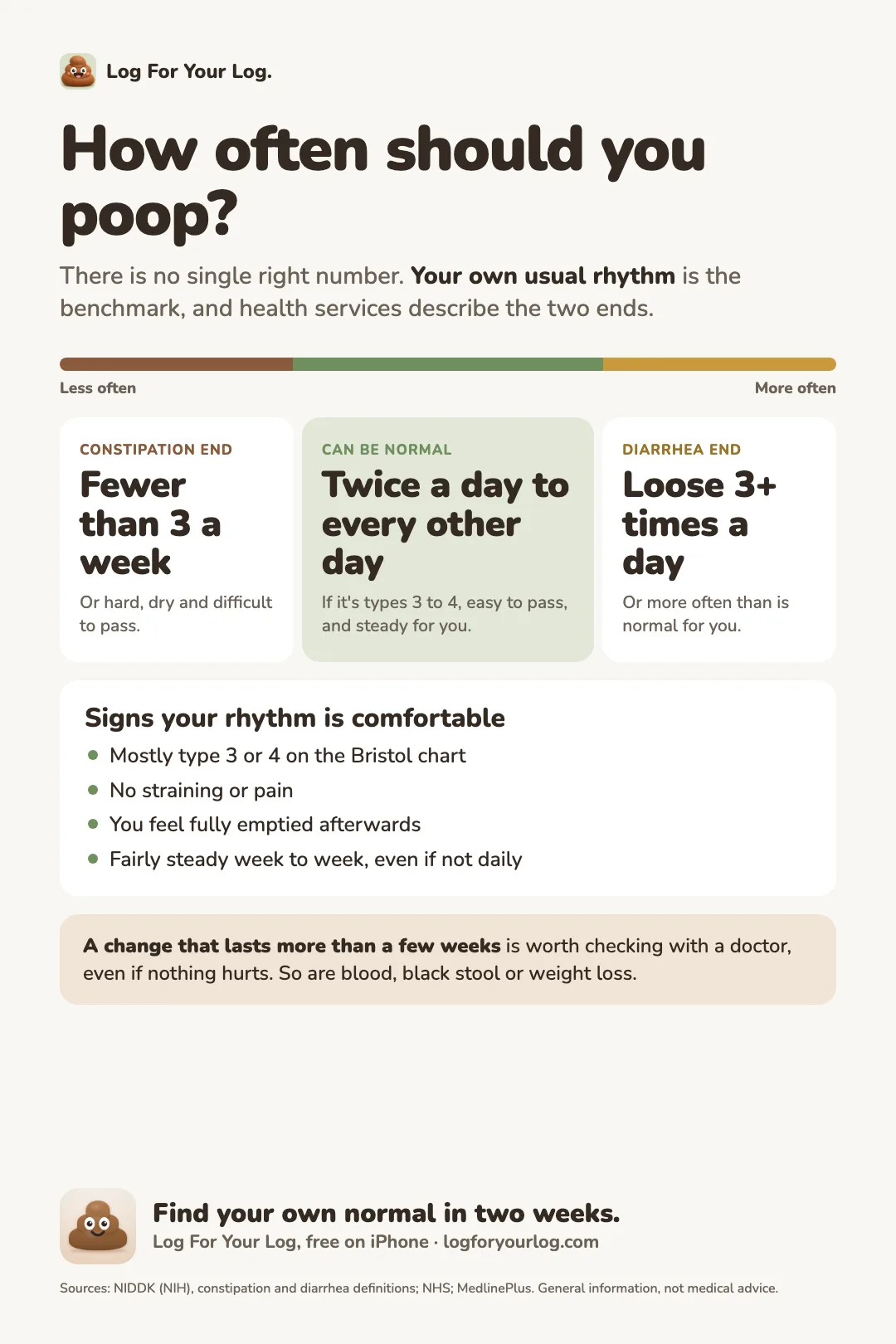
Some people go once or twice a day. Others go every other day and feel completely fine. Health services do not set one right number, and they measure changes against your own usual pattern: the NHS counts "pooing less often than usual" as a sign of constipation, and NIDDK counts going "more often than what is normal for you" as diarrhea.
What they do describe are the two ends. The US National Institute of Diabetes and Digestive and Kidney Diseases (NIDDK) describes constipation as having fewer than three bowel movements a week, or stools that are hard, dry, lumpy or difficult to pass. It describes diarrhea as loose, watery stools three or more times a day, or more often than is normal for you.
Signs your rhythm is comfortable
- Your stool is mostly type 3 or 4 on the Bristol stool chart.
- It passes without straining or pain.
- You feel like you have fully emptied afterwards.
- Your rhythm is fairly steady from week to week, even if it is not daily.
Everyday things that shift your rhythm
Plenty of ordinary things change how often you go. The NHS lists the most common causes of constipation as not eating enough fiber, not drinking enough fluids, moving less, ignoring the urge to go, a change in diet or daily routine (travel counts), stress, and side effects of medicines.
Short changes like these are common and tend to settle once life does. A change that sticks around is different, and is worth writing down.
Going every day is not the goal
Comfort and consistency matter more than a daily streak. Every other day with easy, type 3 or 4 stools can be a perfectly healthy pattern.
How to find your own normal
Memory is bad at this. Most of us cannot say how many times we went last week, let alone what it looked like. A simple two to three week log answers both questions.
- Note each visit with the time and the Bristol type.
- Add context on days that feel off: meals, water, sleep, stress.
- Look at the week, not the day. Count visits per week and see which types show up most.
- Compare like with like. A travel week and a normal week will look different, and that is fine.
Common patterns and what they usually mean
The table sums up official descriptions. It is not a diagnosis, and your own usual rhythm still matters most.
| Pattern | What health services say | Worth a doctor? |
|---|---|---|
| Once or twice a day, types 3 to 4, easy to pass | Within the comfortable range for many people | No, unless it changes and stays changed |
| Every other day, types 3 to 4, no straining | Can be normal: the benchmark is your own usual pattern | No, unless it changes and stays changed |
| Fewer than three times a week, or hard and difficult to pass | Matches NIDDK's description of constipation | If it does not improve with self-care, keeps coming back, or comes with warning signs (NHS) |
| Loose or watery three or more times a day | Matches NIDDK's description of diarrhea | If it lasts more than 2 days or comes with warning signs (NIDDK) |
When a change in frequency matters
A change from your usual pattern that lasts more than a few weeks is a good reason to talk to a doctor, even if nothing hurts. So is any of the signs in the list below. You do not need to wait until it gets worse, and a log of what changed and when makes that conversation easier.
Common questions
Is it normal not to poop every day?
Yes, for many people. Health services do not set a daily target. NIDDK only describes constipation once you have fewer than three bowel movements a week or stools that are hard, dry or difficult to pass.
Is it normal to poop three times a day?
It can be, if the stools are formed and this is your usual pattern. NIDDK describes diarrhea as loose, watery stools three or more times a day, or more often than is normal for you, so both the texture and the change matter.
How long can you go without pooping?
Health services describe going fewer than three times a week as constipation. The NHS suggests seeing a GP if constipation is not getting better with treatment, and NIDDK says to see a doctor right away if it comes with symptoms such as being unable to pass gas, vomiting, fever or constant tummy pain.
Why did my bowel habits suddenly change?
Short changes often follow a change in diet or routine, stress, less fluid or a new medicine, all on the NHS list of common causes. A change that lasts, especially going more or less often than usual, is on the NHS list of bowel changes to get checked.
How can I find out what is normal for me?
Log each visit with a time and Bristol type for two to three weeks, then count visits per week. A paper printable diary or an app both work.
When to talk to a doctor
Contact a doctor promptly if you notice any of these. Get urgent help if you also feel faint, dizzy or very unwell.
- Blood in your stool, or black, tarry stool
- Pale, clay colored or white stool
- Losing weight without trying
- Severe or ongoing tummy pain
- A change in your usual pattern that lasts more than a few weeks
- Diarrhea with signs of dehydration, such as dizziness or very little urine
Sources
- Definition and facts for constipation, NIDDK (NIH)
- Definition and facts for diarrhea, NIDDK (NIH)
- Constipation, NHS
- Bowel movement, MedlinePlus (NIH)
How this page was made. Written by the Log For Your Log team with AI drafting help, based on our in-app Learn library, then checked line by line against the sources below. Read how we write Learn.