Bristol type 2 stool: lumpy and sausage-shaped
Sausage-shaped, but hard and lumpy. Type 2 sits on the constipated side of the Bristol chart. Here is what usually explains it, what health services suggest trying, and when to get checked.
Updated October 21, 2026 · 6 min read · By the Log For Your Log team · 8 sources
 See whether your changes are moving you off type 2. Free on iPhone.Get the app

General information, not medical advice. This page can help you notice patterns and talk with a clinician. It cannot tell you what is causing a symptom.
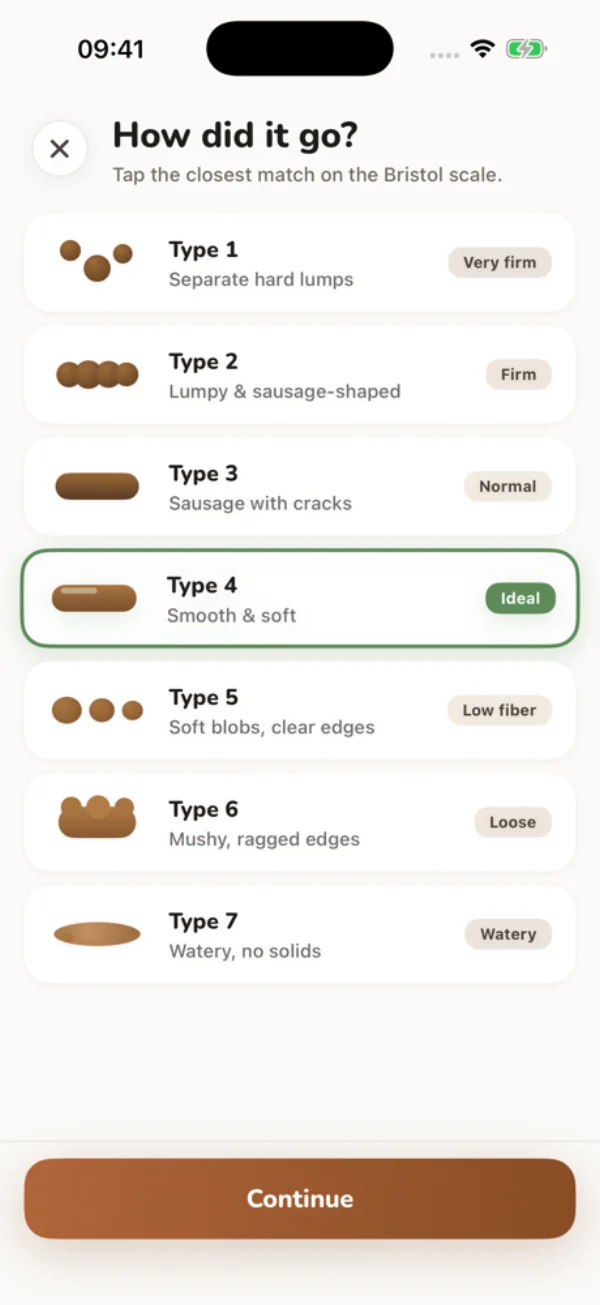
What type 2 looks like
On the Bristol stool chart, type 2 is hard and lumpy, but sausage-shaped (Cleveland Clinic). Think of the separate pebbles of type 1 pressed together into one lumpy piece. It is one step firmer than type 3, which is sausage-shaped with cracks on the surface.
Continence Health Australia groups types 1 and 2 as signs of constipation, and types 3 and 4 as healthy and easy to pass. Cleveland Clinic explains that stools can get like this if they spend too long traveling through your intestines. That matches the 1997 study behind the chart, which found stool form tracked how long food took to pass through the gut more closely than how often people went (Lewis and Heaton).
Is type 2 constipation if I go every day?
It can be. NIDDK describes constipation as any of these: fewer than three bowel movements a week, stools that are hard, dry or lumpy, stools that are difficult or painful to pass, or a feeling that not all stool has passed. So a daily type 2 still fits the hard and lumpy part.
NIDDK also notes that people have different bowel patterns, and only you know what is normal for you. That is why a single type 2 after a long flight matters less than a run of them over a couple of weeks.
| Type | What it looks like | How it is usually grouped |
|---|---|---|
| 1 | Separate hard lumps, like little pebbles | Constipation |
| 2 | Hard and lumpy, but sausage-shaped | Constipation |
| 3 | Sausage-shaped with cracks on the surface | Healthy, easy to pass |
| 4 | Smooth, soft and snakelike | Healthy, easy to pass |
Common reasons for type 2
The NHS says constipation in adults has many possible causes, and sometimes there is no obvious reason. The most common include:
- Not eating enough fiber, which is found in fruits, vegetables and cereals.
- Not drinking enough fluids.
- Not moving enough, or spending long periods sitting or lying down.
- Often ignoring the urge to go to the toilet.
- Changing your diet or daily routine. NIDDK gives travel and changes to how much and what you eat as examples.
- A side effect of a medicine or supplement. NIDDK lists iron supplements and some antacids among those that can make constipation worse. Do not stop a medicine without talking to a health professional first.
- Stress, anxiety or depression.
Everyday changes that may help
The NHS says making simple changes to your diet and lifestyle can help, and you may notice a difference within a few days, although sometimes it takes a few weeks.
- Add fiber slowly. NIDDK says adults should get 22 to 34 grams of fiber a day depending on age and sex, added a little at a time so your body gets used to the change. Good sources include whole grains such as oatmeal, beans and lentils, berries, apples with the skin on, pears, and vegetables such as carrots and broccoli.
- Drink with it. NIDDK says water and other liquids help fiber work better. The NHS suggests drinking plenty of fluids and avoiding alcohol.
- Try a few specific foods. The NHS suggests fruits that contain sorbitol, such as apples, apricots, grapes and raisins, raspberries and strawberries, and adding some wheat bran, oats or linseed.
- Give it a regular slot. NIDDK says trying to go 15 to 45 minutes after breakfast may help, because eating helps your colon move stool. Give yourself enough time, and go as soon as you feel the need.
- Use a footstool. The NHS suggests resting your feet on a low stool, with your knees above your hips if possible.
- Move a bit more. A daily walk or run can help you poo more regularly (NHS).
- Ask a pharmacist if diet and lifestyle changes are not helping. The NHS says laxatives should only be used for a short time.
Change one thing at a time
If you add fiber, water and a morning walk in the same week, you will not know which one helped. Change one thing, log for a week or two, then decide on the next.
What a useful log entry looks like
A few words per bowel movement is enough to see a trend, and it is exactly what a doctor will ask about if things do not improve. For example:
- Monday 8:10 am: type 2, brown. Note: strained, felt like I had not finished.
- Wednesday 7:55 am: type 2. Note: 3 days since last one. Long drive yesterday, not much water.
- Following Monday: type 3. Note: oats at breakfast all week, walking after lunch.
When type 2 needs a doctor
The NHS suggests seeing a GP if you are constipated and it is not getting better with treatment, you are regularly constipated or bloated, you have blood in your poo, you have lost weight without trying, you feel tired all the time, a medicine is causing it, you notice sudden changes in your bowel habits, or you have tummy pain.
NIDDK says to see a doctor right away if constipation comes with bleeding from your rectum or blood in your stool, constant pain in your abdomen, being unable to pass gas, vomiting, fever, lower back pain, or losing weight without trying. It also suggests seeing a doctor if self-care is not working or you have a family history of colon or rectal cancer.
One less obvious sign: the NHS explains that long-term constipation can lead to faecal impaction, where poo builds up in the rectum, and the main symptom is diarrhea leaking around it. If long-standing type 2 suddenly turns into runny leaks, mention that to a GP. Our when to see a doctor guide has the full list of warning signs.
Common questions
Is type 2 stool bad?
It is not dangerous on its own, but it is on the constipated side. Continence Health Australia groups types 1 and 2 as signs of constipation and says healthy stools are soft, well formed and easy to pass, like types 3 and 4. A pattern of type 2 is worth acting on with fiber, fluids and movement.
What does it mean if my type 2 stool is easy to pass?
NIDDK counts hard, dry or lumpy stools as a sign of constipation even when they are not painful to pass. NIDDK also says only you know what is normal for you, so watch the pattern over a week or two rather than one day.
How long do diet changes take to work for type 2 stool?
The NHS says you may notice a difference within a few days, but sometimes it takes a few weeks. Adding fiber gradually, as NIDDK advises, also means changes show up slowly, so give each change time.
When to talk to a doctor
Contact a doctor promptly if you notice any of these. Get urgent help if you also feel faint, dizzy or very unwell.
- Blood in your stool, or black, tarry stool
- Pale, clay colored or white stool
- Losing weight without trying
- Severe or ongoing tummy pain
- A change in your usual pattern that lasts more than a few weeks
- Diarrhea with signs of dehydration, such as dizziness or very little urine
Sources
- Bristol Stool Chart, Continence Health Australia
- Bristol Stool Chart, Cleveland Clinic
- Stool form scale as a useful guide to intestinal transit time, Lewis SJ, Heaton KW. Scandinavian Journal of Gastroenterology, 1997
- Definition and facts for constipation, NIDDK (NIH)
- Symptoms and causes of constipation, NIDDK (NIH)
- Eating, diet and nutrition for constipation, NIDDK (NIH)
- Treatment for constipation, NIDDK (NIH)
- Constipation, NHS
How this page was made. Written by the Log For Your Log team with AI drafting help, based on our in-app Learn library, then checked line by line against the sources below. Read how we write Learn.