Bristol type 3 stool: sausage-shaped with cracks
Sausage-shaped, with a few cracks on the surface. Type 3 sits in the comfortable middle of the Bristol chart. Here is what it says about your gut, why it can still feel like hard work some days, and the few signs worth a doctor's look.
Updated October 22, 2026 · 6 min read · By the Log For Your Log team · 8 sources
 Learn what your normal looks like. Free on iPhone.Get the app

General information, not medical advice. This page can help you notice patterns and talk with a clinician. It cannot tell you what is causing a symptom.
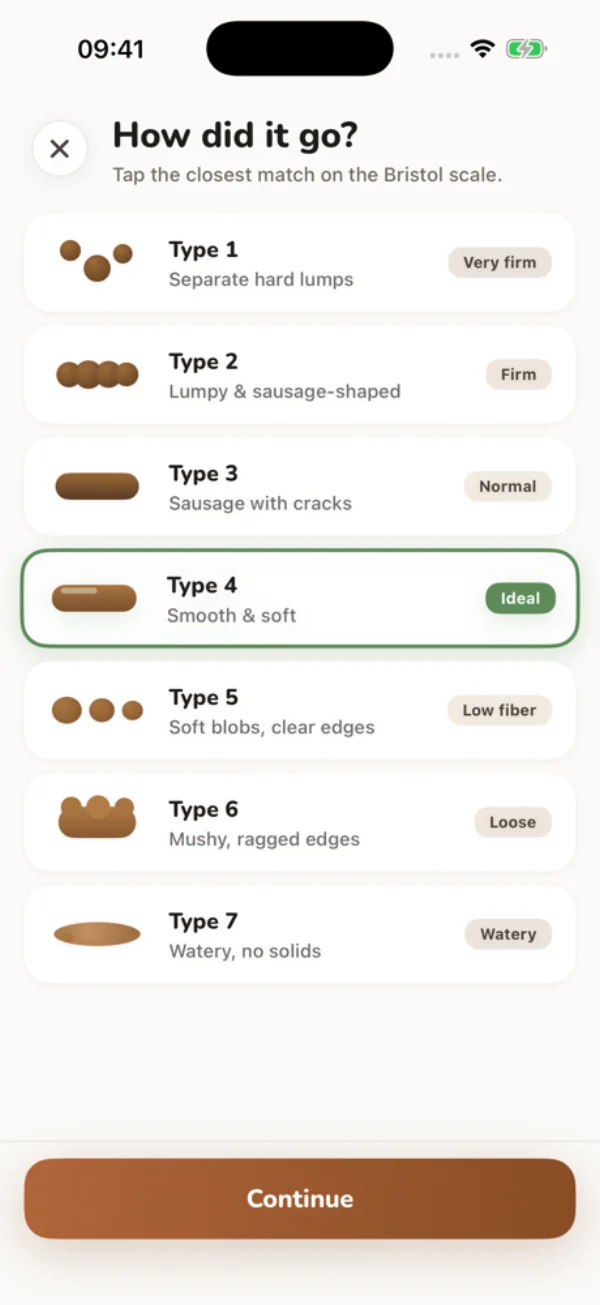
What type 3 looks like
On the Bristol stool chart, type 3 is sausage-shaped, with cracks on the surface (Cleveland Clinic). It is one step softer than type 2, which is sausage-shaped but hard and lumpy, and one step firmer than type 4, which is smooth, soft and snakelike.
Continence Health Australia groups types 3 and 4 together as healthy and easy to pass, and says that although everyone's bowel habits are different, healthy poo should be soft, well formed and easy to pass. Cleveland Clinic goes a step further and calls types 3 and 4 the most ideal. It explains that these stools are condensed enough to hold together, but not too hard or dry to pass, and that they suggest your bowels are moving at a healthy and regular pace.
| Type | What it looks like | How it is usually grouped |
|---|---|---|
| 2 | Hard and lumpy, but sausage-shaped | Constipation |
| 3 | Sausage-shaped, with cracks on the surface | Healthy, easy to pass |
| 4 | Smooth, soft and snakelike | Healthy, easy to pass |
| 5 | Soft blobs with clear-cut edges | Diarrhea or urgency |
What stool shape tells you about your gut
The chart works because shape is a rough guide to how long stool has spent in your gut. In the 1997 study behind the chart, 66 volunteers had their whole-gut transit time measured and kept a diary of their stool form and how often they went. Stool form matched transit time more closely than bowel frequency did, and when transit time was changed, stool form tracked the change best (Lewis and Heaton).
Cleveland Clinic explains the two ends of that scale. Types 1 and 2 can happen when stool spends too long traveling through your intestines. Types 5, 6 and 7 happen when your bowels move too fast and too often and do not absorb enough water. Type 3 sits between those, which is why it is counted as a healthy pace.
It is also normal to wander. Cleveland Clinic says it is normal to have a hard poop or a mushy poop now and then, because what you eat and how much water or alcohol you drink can change your stools from day to day. A single type 2 or type 5 among a week of type 3s is not a pattern.
Type 3, but hard to pass
Shape is only part of the picture. NIDDK describes constipation as fewer than three bowel movements a week, stools that are hard, dry or lumpy, stools that are difficult or painful to pass, or a feeling that not all stool has passed. So a type 3 that you have to strain for, or that leaves you feeling unfinished, can still sit on the constipated side, even though it looks fine.
NIDDK also says people have different bowel patterns and only you know what is normal for you. Mayo Clinic puts the typical range at three times a day to three times a week. If your type 3 comes at your usual rhythm and passes without a fight, there is nothing to fix.
If it does feel like hard work, a few toilet habits may help:
- Raise your knees. The NHS suggests resting your feet on a low stool, with your knees above your hips if possible.
- Give it a regular slot after a meal. NIDDK says trying to go 15 to 45 minutes after breakfast may help, because eating helps your colon move stool. It also suggests trying to relax your muscles while you are there.
- Go when you feel the urge. The NHS advises not delaying when you need to go, and keeping to a regular time and place with plenty of time to use the toilet.
Habits that help keep you at type 3 or 4
There is no special trick to staying in the middle of the chart. It mostly comes down to the same everyday habits that health services suggest for preventing constipation:
- Enough fiber. NIDDK says adults should get 22 to 34 grams of fiber a day, depending on age and sex. The NHS suggests increasing fiber gradually, and adding some wheat bran, oats or linseed.
- Enough to drink. NIDDK says to drink plenty of water and other liquids if you eat more fiber. The NHS suggests plenty of water and other fluids, and avoiding alcohol.
- Regular movement. The NHS says a daily walk or run can help you poo more regularly.
- A regular slot. Mayo Clinic suggests creating a regular schedule for passing stool, especially after a meal, and not ignoring the urge to go.
Know your own normal
Type 3 is a good baseline to log against. Once you know what a typical week looks like for you, a real change is much easier to spot.
What a useful log entry looks like
When things are going well there is not much to write, and that is the point. A short note on the days that feel different gives you something to compare against later. For example:
- Tuesday 7:40 am: type 3, brown. No note.
- Thursday 8:15 am: type 3. Note: took a while, had to strain a bit. Late dinner, not much water.
- Saturday 9:30 am: type 2. Note: long drive yesterday. Back to type 3 by Monday.
When to see a doctor
A healthy shape does not rule out other problems, so the warning signs are the same whatever type you log. The NHS suggests seeing a GP if you have blood in your poo, have lost weight without trying, notice sudden changes in your bowel habits, feel tired all the time, or have tummy pain.
Mayo Clinic also lists blood in your stools or black stools, other unusual changes in the shape or color of stools, stomach pain that does not stop, and weight loss without trying. It also suggests an appointment if constipation symptoms last longer than three weeks or make everyday activities difficult.
Mucus is a common worry too. Cleveland Clinic says it is normal to see some clear mucus in your stool, but a flood of mucus, or mucus that looks bloody, off-white or yellowish, is worth discussing with a healthcare provider. Our when to see a doctor guide has the full list.
Common questions
Is type 3 poop healthy?
Yes, it is in the healthy range. Continence Health Australia groups types 3 and 4 as healthy and easy to pass, and Cleveland Clinic calls them the most ideal.
Is type 3 or type 4 poop better?
Neither is better. Both Continence Health Australia and Cleveland Clinic put types 3 and 4 in the same healthy group. Moving between them from day to day is normal.
Is type 3 stool a sign of constipation?
Not on its own. But NIDDK counts stools that are difficult or painful to pass, a feeling that not all stool has passed, and fewer than three bowel movements a week as symptoms of constipation, whatever the shape. If type 3 comes with any of those, the same fiber, fluid and toilet habits may help.
What does type 3 poop with mucus mean?
Cleveland Clinic says some clear mucus in stool is normal. Contact a healthcare provider if there is a lot of it, or if it looks bloody, off-white or yellowish.
What if I see blood with a type 3 stool?
Get it checked. The NHS lists blood in your poo as a reason to see a GP, and Mayo Clinic lists blood in your stools or black stools. A normal shape does not change that advice.
When to talk to a doctor
Contact a doctor promptly if you notice any of these. Get urgent help if you also feel faint, dizzy or very unwell.
- Blood in your stool, or black, tarry stool
- Pale, clay colored or white stool
- Losing weight without trying
- Severe or ongoing tummy pain
- A change in your usual pattern that lasts more than a few weeks
- Diarrhea with signs of dehydration, such as dizziness or very little urine
Sources
- Bristol Stool Chart, Cleveland Clinic
- Bristol Stool Chart, Continence Health Australia
- Stool form scale as a useful guide to intestinal transit time, Lewis SJ, Heaton KW. Scandinavian Journal of Gastroenterology, 1997
- Definition and facts for constipation, NIDDK (NIH)
- Treatment for constipation, NIDDK (NIH)
- Constipation: symptoms and causes, Mayo Clinic
- Constipation, NHS
- Mucus in stool, Cleveland Clinic
How this page was made. Written by the Log For Your Log team with AI drafting help, based on our in-app Learn library, then checked line by line against the sources below. Read how we write Learn.