How to describe your poop to a doctor
Give the doctor four plain facts: the Bristol type (a number from 1 to 7 for shape), the color, how often you go compared with your usual, and when the change started. Mention any blood, black stool or weight loss first, before anything else.
Updated November 1, 2026 · 8 min read · By the Log For Your Log team · 13 sources
 Need words for your next appointment? Free on iPhone.Get the app

General information, not medical advice. This page can help you notice patterns and talk with a clinician. It cannot tell you what is causing a symptom.
How do you describe poop to a doctor?
Use numbers and plain words instead of feelings: a Bristol type for shape, a color, how many times a day or week, and since when. Doctors ask about exactly these things. NIDDK lists how often you have a bowel movement, how long you have had symptoms and what your stools look like among the questions your doctor is likely to ask, along with whether you have seen red streaks in your stool or blood on the toilet paper.
It can feel awkward to talk about poo. The NHS asks people to try not to be embarrassed, because the doctor or nurse will be used to talking about these symptoms. Plain words like poo, poop or stool are all fine.
What should you mention first?
Start with any warning sign, before shape or color, so it does not get lost at the end of a short appointment. Some of these should not wait for a booked visit at all:
- Call 999 or go to A&E (or your local emergency number) if you are bleeding non-stop from your bottom, or there is a lot of blood or you see large blood clots when you poo (NHS).
- Ask for an urgent GP appointment or get help from NHS 111 if your poo is black or dark red, or you have bloody diarrhea (NHS).
- Talk with a doctor right away for diarrhea lasting more than 2 days, a high fever, six or more loose stools a day, frequent vomiting, severe pain in the abdomen or rectum, stools that are black and tarry or contain red blood or pus, or symptoms of dehydration (NIDDK).
- See a GP if you have had blood in your poo for 3 weeks, or your poo has been softer, thinner or longer than normal for 3 weeks, or you have lost weight for no reason (NHS).
Put it in the first sentence
"I have had blood in my poo on and off for a month" said first gets more attention than the same fact mentioned on the way out the door. Our when to see a doctor guide lists the other warning signs in one place.
How do you describe stool consistency?
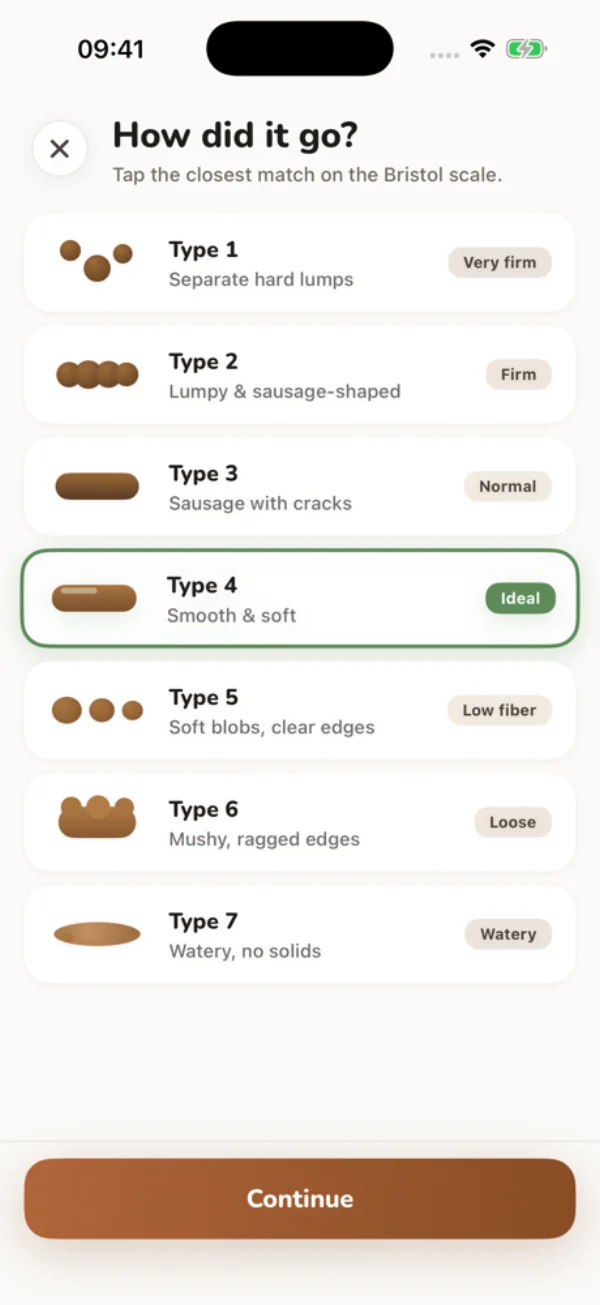
Say the Bristol type number, then a few words of description. Cleveland Clinic says providers use the Bristol Stool Chart to better understand what your stools are like and to classify the type of diarrhea or constipation you have. A number is quicker and less ambiguous than "a bit loose" or "kind of hard".
| Type | What it looks like | How you might say it |
|---|---|---|
| 1 | Separate, hard lumps, like little pebbles | "Type 1, small hard pellets, hard to pass" |
| 2 | Hard and lumpy, but sausage-shaped | "Type 2, lumpy and hard" |
| 3 | Sausage-shaped, with cracks on the surface | "Type 3, formed with cracks" |
| 4 | Smooth, soft and snakelike | "Type 4, smooth and soft" |
| 5 | Soft blobs with clear-cut edges | "Type 5, soft pieces" |
| 6 | Fluffy, mushy pieces with ragged edges | "Type 6, mushy, no real shape" |
| 7 | Watery, liquid poop, with no solid pieces | "Type 7, fully watery" |
- Types 1 and 2 suggest constipation, types 3 and 4 are the most ideal, and types 5, 6 and 7 suggest diarrhea (Cleveland Clinic).
- If your stools vary, say the range and the most common one: "mostly type 6, sometimes 7".
- Add how it felt to pass: easy, straining, painful, urgent, or a feeling that you have not finished. NIDDK lists stools that are difficult or painful to pass and a feeling that not all stool has passed among the signs of constipation.
What color words should you use?
Use one simple color word and say whether something you ate or took could explain it. Cleveland Clinic says brown is the ideal poop color for adults, the shade of brown can vary, and most of the time an unusual color points to something you ate. Our poop color guide goes through each color in more detail.
| Color word | Worth saying alongside it |
|---|---|
| Brown (any shade) | Nothing extra needed. Cleveland Clinic says the shade of brown can vary. |
| Black or tarry | Whether you take iron pills or bismuth medicines (such as Pepto-Bismol), or ate black licorice or blueberries, which MedlinePlus says can also cause black stools. Say "sticky" or "tar-like" if it was. |
| Red or dark red | Whether you ate beets or foods with red coloring, which MedlinePlus says can make stools look reddish. Say whether the red was mixed in, on the surface or only on the paper. |
| Green | Recent leafy greens or green icing. Cleveland Clinic says green can be the spinach you had at lunch, but could also point to an infection or stools passing too fast. |
| Yellow or greasy | Fatty meals, or foods high in beta-carotene like carrots, yams or squash, which Cleveland Clinic names as possible food causes. |
| Pale, clay, white or gray | How many days it has lasted. MedlinePlus says to contact your provider if your stools are not the normal brown color for several days. |
Not sure if it is black or very dark green?
Say exactly that. MedlinePlus notes that your provider can test the stool with a chemical to check for the presence of blood, so an honest "I am not sure" is more useful than a guess.
How do you describe how often you go, and since when?
Give a number per day or per week, compare it with your usual, and name the date or week it changed. NIDDK says people can have different bowel movement patterns and only you know what is normal for you, so "twice a day, when I usually go once" says more than "often".
Two definitions help put numbers in context. NIDDK describes constipation as including fewer than three bowel movements a week, and diarrhea as passing loose, watery stools three or more times a day, or more often than is normal for you. It also sorts diarrhea by how long it lasts: acute typically lasts less than a week, persistent lasts longer than 2 weeks and less than 4, and chronic lasts at least 4 weeks. That is why the start date matters.
Mayo Clinic lists questions a doctor is likely to ask about diarrhea, including when your symptoms began, whether they have been continuous or occasional, and whether your diarrhea wakes you at night. Useful timing words:
- Start: "since about 10 September" or "for about six weeks".
- Pattern: constant, or comes and goes. If it comes and goes, how many bad days a week.
- Time of day: mostly mornings, after meals, or at night. Say if it wakes you up.
- Trend: getting better, worse, or the same.
What other symptoms should you mention?
Mention anything that comes with the change, and what makes it better or worse. MedlinePlus suggests writing down a description of your symptoms, including when they started, what makes them better, and what makes them worse, and making a list of all the medicines, herbs, vitamins and supplements you take. Worth noting:
- Pain: where it is, and whether going to the toilet eases it or makes it worse.
- Blood, mucus or pus: how much, how often, and whether it is in the stool or only on the paper.
- Urgency or accidents: needing to rush, or not making it in time.
- Whole body signs: fever, tiredness, weight change. NIDDK says your doctor may ask if you have recently lost or gained weight.
- Medicines and recent changes: new medicines, antibiotics, travel, or diet changes. Mayo Clinic lists recent antibiotics among the questions about diarrhea.
- Food links: anything you have noticed after particular meals. A food and symptom diary helps here.
What does a good 3-line note look like?
Three short lines, written before the appointment and read aloud or handed over, cover most of the first questions. Use this order:
- Line 1 is the warning sign or the main reason you came.
- Line 2 is shape, color, frequency and start date, compared with your usual.
- Line 3 is everything else: other symptoms, what you have tried, and your medicines. Below is our own example of the format.
Sample note
1. Main worry: Blood on the paper about twice a week since early September. No large amounts, no clots.
2. Poop: Usually type 4 once a day. Since September, type 6 two or three times a day, mostly mornings, brown. Wakes me at night about once a week.
3. Other: Cramps that ease after I go. Lost about 3 kg without trying. Tried cutting out coffee for 2 weeks, no change. Medicines: none besides a daily vitamin D.
Should you bring a log of your bowel movements?
Yes, if you can. NIDDK suggests you may want to track your bowel movements and what your stools look like for several days or weeks before your doctor's visit, and write down or record the information so you can share it.
Any format works if it is easy to read. Our free printable Bristol stool chart and 2 week diary is one option on paper. In Log For Your Log, each entry records Bristol type, color and notes alongside meals, water and symptoms, and Pro adds food and symptom patterns and a PDF report you can bring to your doctor or dietitian. Our appointment prep guide covers what else to bring and which questions to ask.
Common questions
How do I describe my poop to a doctor without feeling embarrassed?
Use a number and a color, which keeps it factual: "type 6, brown, three times a day since September." The NHS asks people to try not to be embarrassed, because doctors and nurses are used to talking about these symptoms. Writing it down first and reading it out also helps.
What is the medical word for poop?
Stool is the usual medical word, and doctors also say bowel movement for the act of going. Continence Health Australia notes that stool is another word used to describe faeces (poo). Any of these words is fine at an appointment.
How do you describe stool consistency medically?
Use the Bristol Stool Chart, which sorts stool into seven types from separate hard lumps (type 1) to watery with no solid pieces (type 7). Cleveland Clinic says providers use it to better understand what your stools are like, and that types 1 and 2 suggest constipation, 3 and 4 are the most ideal, and 5 to 7 suggest diarrhea. Say the number and add a few words, such as "type 6, mushy pieces".
Should I take a photo of my poop for the doctor?
Ask the clinic before sending one. A Bristol type number and a color word usually say the same thing in a few words, and your doctor may ask for a stool sample instead. The NHS notes you may be asked for a poo sample or given a home test kit.
What if my poop changes every day?
Describe the range and the most common type, and how many days of each over a week or two. Mayo Clinic lists whether symptoms have been continuous or occasional among the questions doctors ask, so "comes and goes" is useful information in itself.
When to talk to a doctor
Contact a doctor promptly if you notice any of these. Get urgent help if you also feel faint, dizzy or very unwell.
- Blood in your stool, or black, tarry stool
- Pale, clay colored or white stool
- Losing weight without trying
- Severe or ongoing tummy pain
- A change in your usual pattern that lasts more than a few weeks
- Diarrhea with signs of dehydration, such as dizziness or very little urine
Sources
- Diagnosis of constipation, NIDDK (NIH)
- Definition and facts for constipation, NIDDK (NIH)
- Definition and facts for diarrhea, NIDDK (NIH)
- Symptoms and causes of diarrhea, NIDDK (NIH)
- Symptoms of bowel cancer, NHS
- Bleeding from the bottom (rectal bleeding), NHS
- Bristol Stool Chart, Cleveland Clinic
- What does my stool (poop) color mean?, Cleveland Clinic
- Black or tarry stools, MedlinePlus
- Stools: pale or clay-colored, MedlinePlus
- Talking with your doctor, MedlinePlus
- Diarrhea: diagnosis and treatment, Mayo Clinic
- Bristol stool chart, Continence Health Australia
How this page was made. Written by the Log For Your Log team with AI drafting help, then checked line by line against the NIH, NHS, MedlinePlus, Mayo Clinic and Cleveland Clinic pages listed below. The sample note is our own example, not a clinical template. Read how we write Learn.