Orange poop: what it means and when to ask a doctor
Orange poop is usually caused by something you ate: lots of carrots or carrot juice, sweet potato, squash or pumpkin, or orange food dye. A food tint should fade within a few days; if your poop does not go back to brown, or you feel unwell, talk to a doctor.
Updated November 7, 2026 · 8 min read · By the Log For Your Log team · 8 sources
 Wondering if it was the carrot juice? Free on iPhone.Get the app

General information, not medical advice. This page can help you notice patterns and talk with a clinician. It cannot tell you what is causing a symptom.
What does orange poop mean?
Most of the time, orange poop means you ate something orange. Stool gets its usual brown color from bile, and a Cleveland Clinic gastroenterologist explains that bile levels alone shift the shade a little from day to day, while the foods you eat add a whole rainbow of possibilities (Cleveland Clinic). Orange foods such as sweet potatoes, squash and pumpkin are on that list.
Mayo Clinic says stool comes in a range of colors, that it is generally influenced by what you eat and by the amount of bile in it, and that only rarely does stool color point to a possibly serious intestinal condition. Our poop color guide covers every shade side by side.
Check sooner if
Your poop does not go back to brown within a few days, or the color comes with unexplained weight loss, pain, fatigue, fever or rectal bleeding (Cleveland Clinic). If your stool is bright red or black, which may mean blood, Mayo Clinic says to seek medical attention right away. More detail is in the last section and in our when to see a doctor guide.
Which foods make your poop orange?
Foods rich in beta carotene are the most common reason, with orange food dye close behind. These are the causes the sources name:
| Cause | Examples | What to know |
|---|---|---|
| Carrots and carrot juice | Large servings of carrots, carrot juice | Cleveland Clinic says the beta carotene in carrots can turn poop orange, but you would have to eat a lot, and it is seen more in people who drink a lot of carrot juice. |
| Other orange foods | Sweet potatoes, squash, pumpkin | Cleveland Clinic lists these orange foods among those that can show up in your poop later. |
| Food coloring | Brightly colored frosting, sweets and drinks | Artificial food coloring keeps tinting whatever it touches even after you eat it, says Cleveland Clinic. |
| A medicine: rifampin | The antibiotic rifampin | MedlinePlus lists temporary yellow, reddish-orange or brown discoloration of stool, urine, sweat and tears as a side effect. |
Why do carrots turn poop orange?
Carrots are full of beta carotene, an orange plant pigment. Cleveland Clinic says all that beta carotene is good for you but can turn your waste orange. Its gastroenterologist adds that you would have to eat a lot of carrots, and that they tend to see it more in people who drink a lot of carrot juice. Eating a great many carrots can also turn your skin an orange-like color, a condition called carotenemia.
Carrots are not the only source. MedlinePlus lists orange and yellow vegetables and fruits such as carrots, sweet potatoes, mangos and cantaloupe among the foods that provide vitamin A, and says the deeper or brighter the color of a fruit or vegetable, the more carotenoids it has. It also notes that large amounts of beta carotene will not make you seriously ill, though they can turn the skin yellow or orange, and that the skin goes back to normal once you eat less of it.
So a week of carrot juice, roasted squash soup or a sweet potato heavy meal plan is a very plausible reason for an orange toilet bowl.
Can food dye or medicine cause orange poop?
Yes, both can. Bright frosting and other artificially colored foods can turn poop into some unnatural shades, because, as Cleveland Clinic puts it, food coloring continues tinting whatever it touches even after it is eaten. Orange sweets, sodas, sports drinks and snack coatings are worth remembering when you think back.
Among medicines, the clearest example in the sources is the antibiotic rifampin. MedlinePlus lists temporary discoloration (yellow, reddish-orange or brown) of the skin, teeth, saliva, urine, stool, sweat and tears as a possible side effect, and says to tell your doctor if side effects are severe or do not go away. Do not stop a medicine you were prescribed without talking to a doctor or pharmacist first.
How long does orange poop last?
Usually a day or a few days. A Cleveland Clinic gastroenterologist says any food-related tint should disappear quickly once the source is flushed from your system, and that the process could take a few days (Cleveland Clinic).
Her rule of thumb is to ask yourself how you are feeling. If you feel normal and do not have diarrhea, the majority of the time colored stool comes from something you ate and will settle on its own. If you keep eating the same orange food every day, expect the color to keep coming back until you have a few days without it.
Orange vs yellow poop: what is the difference?
The two overlap: beta carotene foods can push poop toward either shade, but yellow that is also greasy points somewhere different. Cleveland Clinic says yellowish poop could mean you are eating too many fatty foods or foods high in beta carotene like carrots, yams or squash. Mayo Clinic links yellow, greasy, foul-smelling stool with excess fat in the stool, such as from a malabsorption condition. Our yellow poop guide goes into that in more depth.
| Color | Common food or medicine reasons | When it needs attention |
|---|---|---|
| Orange | Carrots or carrot juice, sweet potato, squash, pumpkin, orange food dye, rifampin | If it does not go back to brown within a few days, or comes with other symptoms |
| Yellow | Fatty foods, beta carotene foods like carrots, yams or squash | Yellow, greasy, foul-smelling stool that keeps happening, which Mayo Clinic links to excess fat in the stool |
| Pale or clay-colored | Some medicines, such as antacids with aluminum hydroxide or large doses of bismuth subsalicylate | A lack of bile in stool, which may mean a bile duct blockage (Mayo Clinic). Contact a provider if stools are not brown for several days (MedlinePlus) |
| Red | Beets, cranberries, tomato juice or soup, red food coloring | Bright red or black stool may mean blood: seek medical attention right away (Mayo Clinic) |
- Not sure whether it is red-orange from food or red from blood? Our red poop guide walks through the difference.
- Bright green instead? See green poop, which is usually leafy greens or green dye.
What should I note down?
A color on its own does not say much; a color next to yesterday's meals usually does. For example:
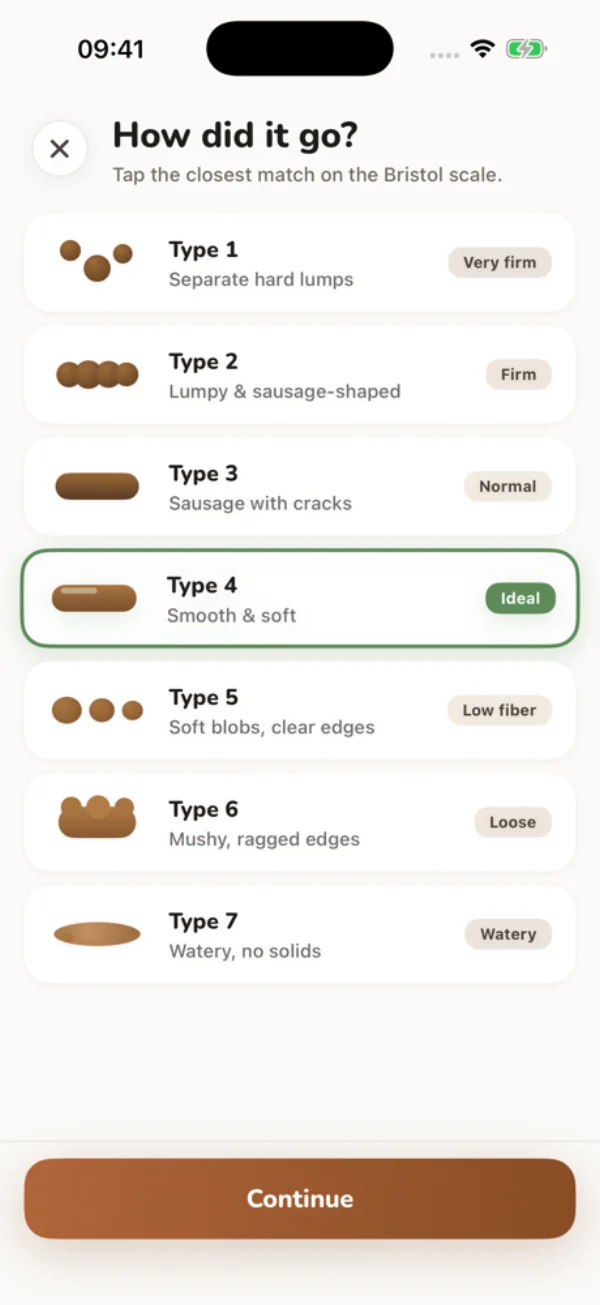
- Monday 7:50 am: type 4, orange. Note: big glass of carrot juice and roasted squash yesterday. Feel fine.
- Wednesday 8:10 am: type 4, brown. Note: no carrots since Monday.
- Following week: orange most days, no carrots or dye I can think of, more tired than usual. Booked a doctor's appointment.
When should I see a doctor about orange poop?
See a healthcare provider if the color will not go back to brown, or if it comes with other symptoms. These are the thresholds the sources give:
- Color that does not go back to brown within a few days. Cleveland Clinic says to contact a healthcare provider, and that a color that lingers for a few days or weeks may be a sign of something more serious.
- Color with other symptoms. Cleveland Clinic says to touch base with a provider if your poop will not go back to brown, especially with unexplained weight loss, pain, fatigue, fever or rectal bleeding, which its gastroenterologist calls alarm features that deserve prompt medical attention (Cleveland Clinic).
- Bright red or black stool. Mayo Clinic says this may indicate blood and to seek medical attention right away. In the UK, the NHS says to ask for an urgent GP appointment or get help from NHS 111 if your poo is black or dark red, or you have bloody diarrhoea.
- Pale or clay-colored stools, yellow skin or dark urine. MedlinePlus says to contact your provider if your stools are not the normal brown color for several days, and notes that yellow skin (jaundice) and dark urine can occur with clay-colored stools.
- Orange diarrhea. NIDDK says adults should talk with a doctor right away if diarrhea lasts more than 2 days, or comes with high fever, six or more loose stools a day, frequent vomiting, severe pain in the abdomen or rectum, stools that are black and tarry or contain red blood or pus, or signs of dehydration such as extreme thirst, urinating less than usual, or feeling dizzy or lightheaded.
Common questions
Is orange poop normal?
An occasional orange poop is usually about food. Cleveland Clinic says a few random, off-color poops do not mean you are unhealthy, and that once the food is out of your system your poop should return to brown. If it stays orange for more than a few days, contact a healthcare provider.
Can carrots make your poop orange?
Yes. Cleveland Clinic says the beta carotene in carrots can turn your poop orange, though you would have to eat a lot of them. It is seen more often in people who drink a lot of carrot juice.
How long after eating carrots does poop turn orange, and for how long?
The sources do not give an exact timing for when the color appears. A Cleveland Clinic gastroenterologist says a food-related tint should disappear once the source is flushed from your system, and that this could take a few days. If the color does not go back to brown within a few days, Cleveland Clinic suggests contacting a healthcare provider.
Can medicine turn poop orange?
Some can. MedlinePlus lists temporary yellow, reddish-orange or brown discoloration of stool as a side effect of the antibiotic rifampin. If you take a medicine and notice a color change, ask your pharmacist or doctor, and do not stop a prescribed medicine on your own.
What is the difference between orange and yellow poop?
Both can come from beta carotene foods like carrots or squash. Yellow poop that is also greasy and foul-smelling is different: Mayo Clinic links it to excess fat in the stool, which is worth raising with a doctor if it keeps happening.
When to talk to a doctor
Contact a doctor promptly if you notice any of these. Get urgent help if you also feel faint, dizzy or very unwell.
- Blood in your stool, or black, tarry stool
- Pale, clay colored or white stool
- Losing weight without trying
- Severe or ongoing tummy pain
- A change in your usual pattern that lasts more than a few weeks
- Diarrhea with signs of dehydration, such as dizziness or very little urine
Sources
- Can food change the color of your poop?, Cleveland Clinic
- What does my stool (poop) color mean?, Cleveland Clinic
- Stool color: When to worry, Mayo Clinic
- Vitamin A, MedlinePlus
- Rifampin, MedlinePlus
- Stools: pale or clay-colored, MedlinePlus
- Symptoms and causes of diarrhea, NIDDK (NIH)
- Symptoms of bowel cancer, NHS
How this page was made. Written by the Log For Your Log team with AI drafting help, then checked line by line against the sources below. Read how we write Learn.