Fiber and water for regularity: how much you need
Fiber and fluids are the first things health services suggest for hard or infrequent stools. Here is how much fiber adults need, how to add it without a week of bloating, and where water fits in.
Updated October 21, 2026 · 7 min read · By the Log For Your Log team · 8 sources
 See whether more fiber and water are working for you. Free on iPhone.Get the app

General information, not medical advice. This page can help you notice patterns and talk with a clinician. It cannot tell you what is causing a symptom.
How much fiber per day?
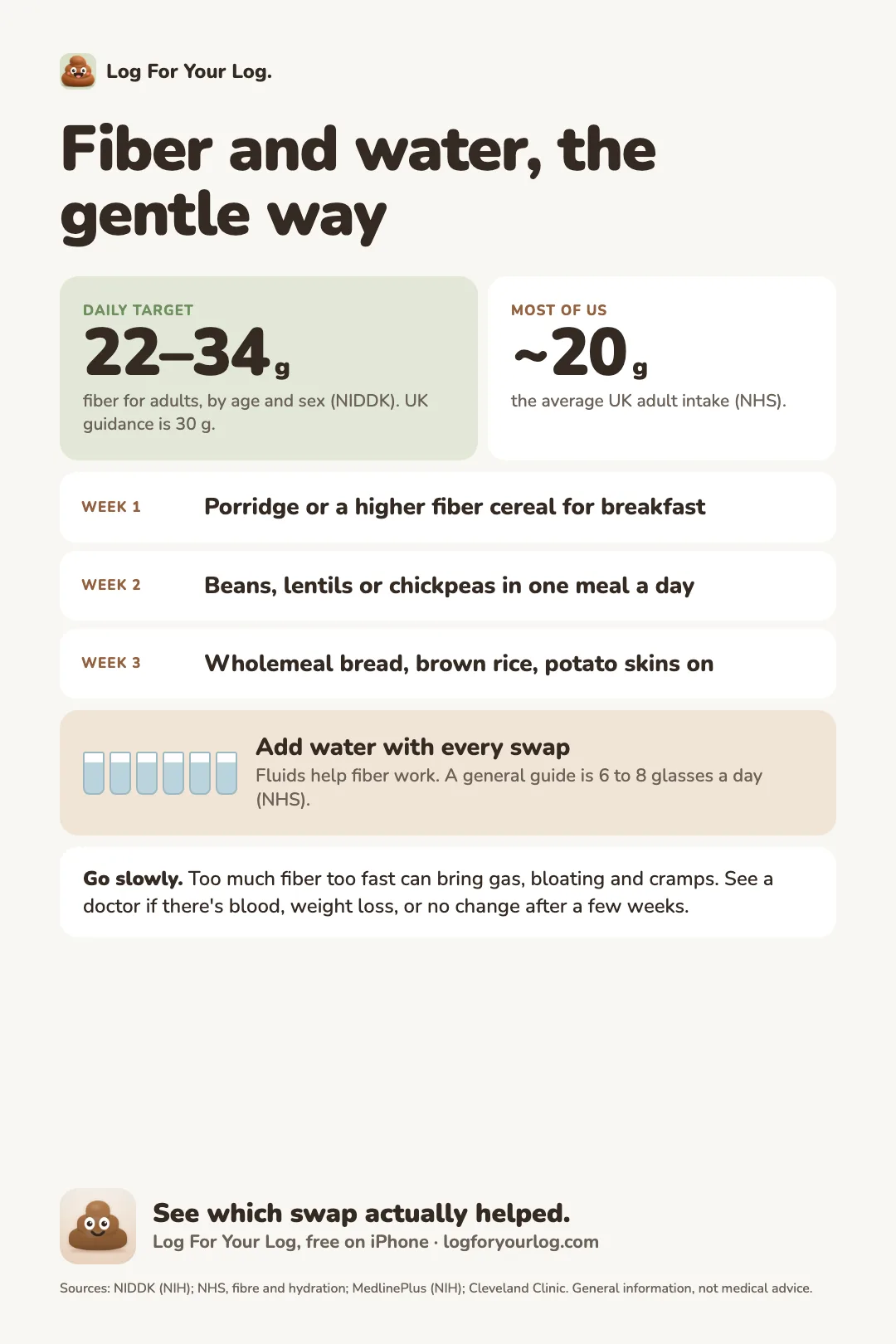
NIDDK says that, depending on age and sex, adults should get 22 to 34 grams of fiber a day. In the UK, the NHS says government guidelines put dietary fiber at 30 grams a day as part of a healthy balanced diet.
Cleveland Clinic sets out how the US figures break down by age and sex, using the Dietary Guidelines for Americans 2020 to 2025:
| Age | Women | Men |
|---|---|---|
| 19 to 30 | 28 grams | 34 grams |
| 31 to 50 | 25 grams | 31 grams |
| 51 and older | 22 grams | 28 grams |
- Most of us fall short. The NHS says most adults are only eating an average of about 20 grams a day. Cleveland Clinic says most people in the US get only about 16 grams.
- These are starting points. A dietitian quoted by Cleveland Clinic notes that the official figures do not account for differences like weight, height and overall health. NIDDK suggests talking with a health care professional, such as a dietitian, to plan meals with the right amount of fiber for you.
How fiber helps you poop
MedlinePlus says fiber aids digestion and helps prevent constipation, and describes two forms that work in different ways. Soluble fiber attracts water and turns to gel during digestion. It is found in oat bran, barley, nuts, seeds, beans, lentils, peas and some fruits and vegetables. Insoluble fiber does not dissolve in water. It is found in foods such as wheat bran, vegetables and whole grains, and it adds bulk to stool and helps food move more quickly through the stomach and intestines.
Most high fiber foods contain both types, MedlinePlus adds, which is why it recommends eating a variety of vegetables, fruits, whole grains, legumes and beans rather than leaning on one food. The NHS makes the same point: get fiber from a variety of sources.
Does water help you poop?
Water works as fiber's partner. NIDDK advises drinking water and other liquids, such as naturally sweetened fruit and vegetable juices and clear soups, to help fiber work better, and says this change should make your stools softer and easier to pass. MedlinePlus puts it simply: water helps fiber pass through the digestive system.
Fluids matter on their own too. The NHS lists not drinking enough fluids among the most common causes of constipation in adults, and NIDDK says staying hydrated can help you avoid getting constipated. Cleveland Clinic warns that if you add fiber without drinking plenty of water, it can lead to constipation.
How much to drink depends on you. NIDDK suggests asking a health care professional how much liquid you should drink each day based on your size, health, activity level and where you live. As a general guide, the NHS says to aim for 6 to 8 cups or glasses of fluid a day, and enough that your pee is a clear pale yellow. You may need more in a hot environment, when you are physically active for long periods, or when you are ill. Water, lower fat milk and lower sugar drinks, including tea and coffee, all count. For constipation, the NHS also suggests avoiding alcohol.
Add fiber gradually
NIDDK says to add fiber to your diet a little at a time so your body gets used to the change. MedlinePlus says to add it gradually over a period of a few weeks to avoid stomach distress, and explains that eating a lot of fiber in a short time can cause gas, bloating and cramps, a problem that often goes away once the natural bacteria in your gut get used to the increase. A dietitian quoted by Cleveland Clinic suggests adding no more than 5 grams of fiber per week until you reach your goal.
In practice, that looks like one small swap at a time:
- Week 1: swap your usual breakfast for porridge or a higher fiber cereal. Keep everything else the same.
- Week 2: add beans, lentils or chickpeas to one meal a day, such as a stew, curry or salad (an NHS suggestion).
- Week 3: switch to wholemeal bread or brown rice, and keep the skins on potatoes.
- Every week: add a glass of water with each fiber swap, and log your stools so you can see what changed.
Log one change at a time
If you add fiber, water and a daily walk in the same week, you will not know which helped. Change one thing, log your Bristol type for a week or two, then decide on the next step.
Good sources of fiber
NIDDK lists these as good sources of fiber:
| Meal | About |
|---|---|
| 2 slices of wholemeal toast with peanut butter, then a medium orange | 8.3 grams |
| Wholemeal spaghetti with lentil and tomato sauce | 11 grams |
| Grilled chicken breast, skin on baked potato, carrots and green beans | 11.2 grams |
- Whole grains, such as whole wheat bread and pasta, oatmeal and bran flake cereals.
- Legumes, such as lentils, black beans, kidney beans, soybeans and chickpeas.
- Fruits, such as berries, apples with the skin on, oranges and pears.
- Vegetables, such as carrots, broccoli, green peas and collard greens.
- Nuts, such as almonds, peanuts and pecans.
Reading labels and avoiding low fiber traps
The NHS says that on food labels, high fiber foods have 6 grams or more of fiber in every 100 grams. It also notes that its meal examples are only illustrations, because the fiber in any food depends on how it is made or prepared and how much you eat.
NIDDK suggests that to help prevent or relieve constipation, you avoid foods with little to no fiber, such as some prepared frozen meals and snack foods, and processed foods such as hot dogs or some microwavable dinners. MedlinePlus adds that taking the peels off fruits and vegetables reduces the fiber you get.
When fiber and water are not helping
Give changes a fair trial. The NHS says you may notice a difference within a few days, though sometimes it takes a few weeks. It suggests a regular time and place for the toilet, not delaying when you feel the urge, and a daily walk or run. If diet and lifestyle changes are not helping, the NHS suggests speaking to a pharmacist.
The NHS says to see a GP if constipation is not getting better with treatment, if you are regularly constipated or regularly bloated, if you have blood in your poo, have lost weight without trying, feel tired all the time, think a medicine is causing it, or notice sudden changes in your bowel habits. NIDDK says to see a doctor right away if constipation comes with bleeding from your rectum, blood in your stool, constant pain in your abdomen, being unable to pass gas, vomiting, fever, lower back pain or losing weight without trying. See also Bristol type 1 and how often should you poop.
Common questions
How much fiber should I eat a day?
NIDDK says adults should get 22 to 34 grams a day depending on age and sex. In the UK, the NHS guideline is 30 grams a day. A dietitian can help you set the right amount for you.
Does water help you poop?
It helps fiber do its job. NIDDK says drinking water and other liquids helps fiber work better and should make stools softer and easier to pass. The NHS lists not drinking enough fluids as a common cause of constipation.
Can fiber make constipation worse?
It can if you add it without enough fluid. Cleveland Clinic says that if you add fiber without drinking plenty of water, it can lead to constipation. Adding it too quickly can also cause gas, bloating and cramps, according to MedlinePlus.
How long does it take for fiber to help constipation?
The NHS says that after diet and lifestyle changes you may notice a difference within a few days, but sometimes it takes a few weeks. If nothing is improving, speak to a pharmacist or see a GP.
When to talk to a doctor
Contact a doctor promptly if you notice any of these. Get urgent help if you also feel faint, dizzy or very unwell.
- Blood in your stool, or black, tarry stool
- Pale, clay colored or white stool
- Losing weight without trying
- Severe or ongoing tummy pain
- A change in your usual pattern that lasts more than a few weeks
- Diarrhea with signs of dehydration, such as dizziness or very little urine
Sources
- Eating, diet and nutrition for constipation, NIDDK (NIH)
- Symptoms and causes of constipation, NIDDK (NIH)
- How to get more fibre into your diet, NHS
- Water, drinks and hydration, NHS
- Constipation, NHS
- Fiber, MedlinePlus (NIH)
- Dietary fiber, MedlinePlus (NIH)
- How much fiber do you need per day?, Cleveland Clinic
How this page was made. Written by the Log For Your Log team with AI drafting help, based on our in-app Learn library, then checked line by line against the sources below. Read how we write Learn.